
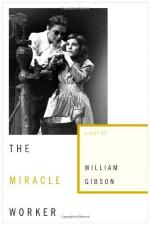
Consider the image of the young Helen Keller that aches like a wound at the center of Mr. William Gibson's "The Miracle Worker": the child locked in the body's cage against sight, speech, sound, her skin alone a raw key to the world, the very fact of her a majestic rebuke to all easy imaginations of justice and rationality. Mr. Gibson's account of the breaking of that cage—of Anne Sullivan's forceful entry into a demonic world of lawless, feral impulse—is scrupulously sincere and affecting always, what I should call an accomplishment in humane feeling. It touches on the mute, clawing Helen with distinguished pathos and on her resistance to Miss Sullivan with a tough-minded love. Everywhere, in these passages, the image is close and powerful, beyond analysis in its emotional purity. Elsewhere, the play has no more than a conventional aspect: busy details in realism too insignificant to bear examination. What comes about us finally with the shadow of radiance—in that moment when the broken circuit of speech and thought and sound is healed at last—is something of the fierce joy of expression, of that poet's glory in the power to name God's things in all their first being and beauty. It is the only point at which Mr. Gibson raises his substance to a pitch of impersonal exaltation, but it is overwhelming. Out of hideous darkness into light: the image is completed, and it is all….
Mr. Gibson's play has taken the town, yet what will defeat the legitimate impulse and distinction of "The Miracle Worker" is, of course, to value it immoderately. I am most anxious to be understood on this point, not as a critical harpy, nor out of perversity, but in justice to those possibilities of theater which Mr. Gibson, quite honorably and doubtless with intent, does not even explore. The triumph of Miss Keller, the will and devotion of Miss Sullivan, are moral splendors of human history, very much on the order of Franklin Roosevelt's conquest of paralysis. They are intrinsically dramatic; they challenge that supine acquiescence by which we defend ourselves against the fact of ostensibly irremediable fatality. They are, if you will, "affirmations of the human spirit."
This is a free excerpt of 363 words. There are 520 words (approx.
2 pages at 300 words per page) in the full critical essay.
Read the rest of this Criticism with our Gibson, William 1914–: Critical Essay by Richard Hayes Access Pass.

