
BookRags.com Literature Guides Literature
Guides
Criticism & Essays Criticism &
Essays
Questions & Answers Questions &
Answers
Lesson Plans Lesson
Plans
My Bibliography Periodic Table U.S. Presidents Shakespeare Sonnet Shake-Up
Research Anything:        
History | Encyclopedias | Films | News | Create a Bibliography | More... Login | Register | Help

Not What You Meant?  There are 8 definitions for Famous Last Words.

Findley, Timothy 1930–: Critical Essay by Ian Mclachlan

Print-Friendly  Order the PDF version  Order the RTF version
About 4 pages (1,243 words)
Timothy Findley Summary

Bookmark and Share Questions on this topic? Just ask!

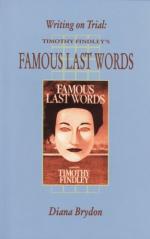
[The protagonist of Pound's modernist poem "Hugh Selwyn Mauberley"] is the main character—initially, at least—in Timothy Findley's new novel, Famous Last Words. Immediately, one recognizes it as a brilliant idea that sparks a variety of possibilities in the reader's imagination. Findley has re-invented Mauberley for his own purposes, making him a younger man than Pound's, American, and a novelist. But any artist—according to Brecht, anyway—has the right to steal another man's work, provided he transforms it in the process. And it's in that transformation that the roots of our initial excitement grow. Pound's Mauberley was a symptom of a world that had apparently been wiped out by the First World War. Findley revives him and uses him to examine the way in which that old world of class and style had not been eliminated after all, but went on clinging to its power with increasing avidity for another 20 years or more. (Even now, has its grip been broken?) Naturally enough, Findley's Mauberley, like Pound, is drawn to fascism, but a fascism attenuated and sweetened by the desire to reconcile itself to the pretences and subtleties of an older aristocratic tradition. The Duke of Windsor for Führer?!

The concept is a fine one. It affords Findley the freedom to move easily between the old hypocrisies and the new barbarism that was replacing them in the 1930s. In the process there's a lovely, wicked irony: that Pound's alter ego, whom he had used to liberate himself from the past, should now be used to expose the political falsehoods that he in his own due course was seduced by.

This is a free excerpt of 266 words. There are 1,243 words (approx. 4 pages at 300 words per page) in the full critical essay.

Read the rest of this Criticism with our Findley, Timothy 1930–: Critical Essay by Ian Mclachlan Access Pass.

Ask any question on Timothy Findley and get it answered FAST!
Answer questions in BookRags Q&A and earn points toward
discounted or even FREE Study Guides and other BookRags products!
Learn more about BookRags Q&A
Copyrights
Findley, Timothy 1930–: Critical Essay by Ian Mclachlan from Literature Criticism Series. ©2005-2006 Thomson Gale, a part of the Thomson Corporation. All rights reserved.

Join BookRagslearn moreJoin BookRags


About BookRags | Customer Service | Report an Error | Terms of Use | Privacy Policy

