
 Print
Print Word
Word PDF
PDF|
This section contains 2,354 words (approx. 8 pages at 300 words per page) |

|
SOURCE: "Anatomy of Fear in Tolstoy and Hemingway," in Lost Generation Journal, Vol. 3, No. 2, Spring-Summer, 1975, pp.
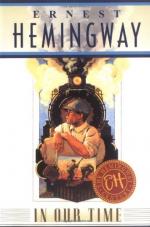
In the following essay, Bordinat focuses on passages from Leo Tolstoy's War and Peace and Ernest Hemingway's In Our Time to define two types of battle narrative: "actual," in which a soldier's real terror is disclosed, and "acceptable," in which the facts of war are recorded without reference to individual response.
In 1934, Ernest Hemingway wrote in Esquire, "Read War and Peace… and see how true and lasting and important the people and the action are.… That is the hardest thing to do."1 In 1925, Hemingway's first wife, Hadley, indicated that he carried War and Peace all over Spain the previous summer.2 No attempt is made here to trace a Tolstoian influence, if indeed one exists. Rather, consideration will be given to Tolstoy's war writings to explain the effectiveness of two passages from In...
|
This section contains 2,354 words (approx. 8 pages at 300 words per page) |
|



