
BookRags.com Literature Guides Literature Guides Criticism/Essays Criticism/Essays Biographies Biographies My Bibliography Periodic Table U.S. Presidents Shakespeare Sonnet Shake-Up
Research Anything:        
History | Encyclopedias | Films | News | Create a Bibliography | More... Login | Register | Help
Not What You Meant?  There are 26 definitions for Endgame.

Search "Endgame: Critical Essay by Hugh Kenner"

Criticism Navigation
 

Endgame: Critical Essay by Hugh Kenner

Print-Friendly  Order the PDF version  Order the RTF version
Samuel Beckett
About 10 pages (3,079 words)
Endgame (play) Summary

Bookmark and Share

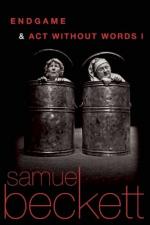
The stage is a place to wait. The place itself waits, when no one is in it. When the curtain rises on Endgame, sheets drape all visible objects as in a furniture warehouse. Clov's first act is to uncurtain the two high windows and inspect the universe; his second is to remove the sheets and fold them carefully over his arm, disclosing two ash cans and a figure in an armchair. This is so plainly a metaphor for waking up that we fancy the stage, with its high peepholes, to be the inside of an immense skull. It is also a ritual for starting the play; Yeats arranged such a ritual for At the Hawk's Well, and specified a black cloth and a symbolic song. It is finally a removal from symbolic storage of the objects that will be needed during the course of the performance. When the theater is empty it is sensible to keep them covered against dust. So we are reminded at the outset that what we are to witness is a dusty dramatic exhibition, repeated and repeatable. The necessary objects include three additional players (two of them in ash cans). Since none of them will move from his station we can think of them after the performance as being kept permanently on stage, and covered with their dust cloths again until tomorrow night.

The rising of the curtain disclosed these sheeted forms; the removal of the sheets disclosed the protagonist and his ash cans; the next stage is for the protagonist to uncover his own face, which he does with a yawn, culminating this three-phase strip tease with the revelation of a very red face and black glasses. His name, we gather from the program, is Hamm, a name for an actor. He is also Hamlet, bounded in a nutshell, fancying himself king of infinite space, but troubled by bad dreams; he is also "a toppled Prospero," remarking partway through the play, with judicious pedantry, "our revels now are ended"; he is also the Hammer to which Clov, Nagg and Nell (Fr. clou, Ger. Nagel, Eng. nail) stand in passive relationship; by extension, a chess player ("Me—[he yawns]—to play"); but also (since Clov must wheel him about) himself a chessman, probably the imperiled King.

This is a free excerpt of 377 words. There are 3,079 words (approx. 10 pages at 300 words per page) in the full critical essay.

Read the rest of this Criticism with our Endgame: Critical Essay by Hugh Kenner Access Pass.

 
Copyrights
Endgame: Critical Essay by Hugh Kenner from Literature Criticism Series. ©2005-2006 Thomson Gale, a part of the Thomson Corporation. All rights reserved.

Join BookRagslearn moreJoin BookRags


About BookRags | Customer Service | Report an Error | Terms of Use | Privacy Policy

