
BookRags.com Literature Guides Literature Guides Criticism/Essays Criticism/Essays Biographies Biographies My Bibliography Periodic Table U.S. Presidents Shakespeare Sonnet Shake-Up
Research Anything:        
History | Encyclopedias | Films | News | Create a Bibliography | More... Login | Register | Help

Search "Eliot, T(homas) S(tearns) 1888–1965: Critical Essay by Ann P. Brady"

Criticism Navigation

Eliot, T(homas) S(tearns) 1888–1965: Critical Essay by Ann P. Brady

Print-Friendly  Order the PDF version  Order the RTF version
About 14 pages (4,285 words)
T. S. Eliot Summary

Bookmark and Share

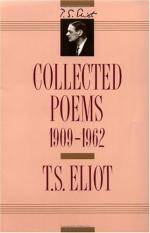
The object of this study is to investigate T. S. Eliot in regard to that very elusive and omnipresent genre of literary history, the lyric. Eliot is a very good practitioner in lyric poetry and continually comments on the art of the lyric in his critical works. An examination of his finest lyric practice in the light of his theory on the subject will further illuminate the unity of Eliot as poet and critic, and quite possibly shed more light on the Four Quartets, whose core passages are self-contained lyrics of a very high caliber, each one emanating from a time-honored tradition yet each remarkably original. Truly these lyrics embody the double quality Eliot praises in "Tradition and the Individual Talent" in 1919: " … we shall often find that not only the best, but the most individual parts of [a poet's] work may be those in which the dead poets, his ancestors, assert their immortality most vigorously." Nowhere is Eliot more original than in these lyrics, and nowhere are the voices of the lyric tradition more clearly heard in his work. (p. 4)

As a lyric practitioner T. S. Eliot developed to a considerable degree toward clarity. His early lyrics, for example, do not exemplify so well or so consistently those qualities peculiarly necessary for lyric verse which characterize the later works. The obscure characters and the difficult syntax endemic to Eliot through the 1920s are inimical to the sort of clarity demanded of lyric verse. The later poetry, however, presents its own problems to readers who are insensible to the religious nature of its content. The problem of communication, whether due to obscurity in manner and content or to reader incapacity, remains a factor throughout Eliot's poetic career and may not be skirted. (p. 10)

This is a free excerpt of 296 words. There are 4,285 words (approx. 14 pages at 300 words per page) in the full critical essay.

Read the rest of this Criticism with our Eliot, T(homas) S(tearns) 1888–1965: Critical Essay by Ann P. Brady Access Pass.

Copyrights
Eliot, T(homas) S(tearns) 1888–1965: Critical Essay by Ann P. Brady from Literature Criticism Series. ©2005-2006 Thomson Gale, a part of the Thomson Corporation. All rights reserved.

Join BookRagslearn moreJoin BookRags


About BookRags | Customer Service | Report an Error | Terms of Use | Privacy Policy

