
BookRags.com Literature Guides Literature Guides Criticism/Essays Criticism/Essays Biographies Biographies My Bibliography Periodic Table U.S. Presidents Shakespeare Sonnet Shake-Up
Research Anything:        
History | Encyclopedias | Films | News | Create a Bibliography | More... Login | Register | Help
Not What You Meant?  There are 38 definitions for Eliot.

Search "Eliot, T(homas) S(tearns) 1888–1965: Critical Essay by Calvin Bedient"

Criticism Navigation


Eliot, T(homas) S(tearns) 1888–1965: Critical Essay by Calvin Bedient

Print-Friendly  Order the PDF version  Order the RTF version
About 2 pages (445 words)
T. S. Eliot Summary

Bookmark and Share

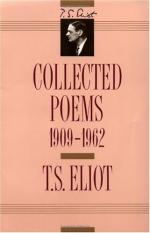
The Eliot of 'Gerontion' and 'The Hollow Men' … is a quasi-Absentist, his protagonists the seeming victims of an incapacitated faith. The poems tempt us to share despair—at least they feel their way into it with a relish. At the same time they allow us to infer that not faith but the protagonists are to blame. They may be said to refer Christian belief to the reader and even to judge and as it were wait to receive the repentant speakers, who meanwhile enjoy their backwardness. So somehow the 'sightless' hollow men know that a holy plenitude is possible for others—others have crossed the tumid river with 'direct eyes, to death's other Kingdom'. Their desert Absentist realm, with its belatedness, its impotency, is not then the only kingdom, the only death. Now for the Absentist, absence is irremediable and insuperable; it pervades and limits everything; the 'broken jaw of our lost kingdoms' is all. By contrast, the hollow men torture themselves with knowledge of a numinous other realm—and please themselves by hanging back from it. 'Let me be no nearer', they pray as it were inversely, 'Let me also wear / deliberate disguises'. What is this if not self-willed? Their despair is disingenous.

Yet, spurious as spiritual destitution may be in his poems, Eliot provided models for Absentist forms. Introducing into English poetry an 'insidious' principle of disorientation, he dispersed the spatial and temporal closures of traditional verse. He exposed the medium itself to hesitations and reluctances, frustrations and panics. And he forced it to acknowledge the negative otherness of the world and the precipitate, arhythmic progress of mortality.

This is a free excerpt of 268 words. There are 445 words (approx. 1 page at 300 words per page) in the full critical essay.

Read the rest of this Criticism with our Eliot, T(homas) S(tearns) 1888–1965: Critical Essay by Calvin Bedient Access Pass.

Copyrights
Eliot, T(homas) S(tearns) 1888–1965: Critical Essay by Calvin Bedient from Literature Criticism Series. ©2005-2006 Thomson Gale, a part of the Thomson Corporation. All rights reserved.

Join BookRagslearn moreJoin BookRags


About BookRags | Customer Service | Report an Error | Terms of Use | Privacy Policy

