
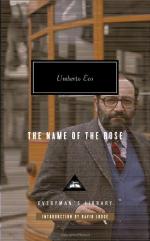
There is something of the sleuth in any scholar; small wonder, therefore, that one as flamboyantly articulate as Umberto Eco should have successfully turned his talents to the writing of a detective story, Il nome della rosa. But this, Eco's first novel, is no mere detective story; rather, its framework serves as a vehicle for nothing less than a summa of all the author knows about the Middle Ages—and all he wishes us to know…. Eco's rare gift for epitome has a chance to shine forth in this book and his own delight in his task is often infectious. At the same time, this very delight carries a risk: one is intermittently reminded of novels by Jules Verne such as Around the Moon, in which the author's desire to impart knowledge has carried him away, and leaves the reader toiling along behind, a little baffled. Still, like Verne, Eco exhibits a winning confidence in his own power to recapture our attention.
Much ingenuity has gone into the plot. The action is set in a major Benedictine abbey in Northern Italy, in the turbulent year 1327. All over Europe the Church is persecuting the so-called Fraticelli, followers of a lapsed Franciscan, fra' Dolcino who was burnt at the stake twenty years earlier, and whose advocacy of total poverty may, it is feared, cause anarchy, and undermine the secular power of the Church. For this very reason the Emperor is encouraging the movement. A Franciscan brother, an Englishman with the Holmesian name of Guglielmo da Baskerville (his Watson, called Adso, tells the story; these, and the novel's Shakespearean title, are by no means Eco's only homage to English culture) arrives at the abbey to act as mediator between the forces of tolerance and the Pope's inquisitor, the chief persecutor of the Dolcinians, who is due to stop there on his way to the South. The newcomers find the abbey in turmoil after the sudden and violent death of a monk, and Baskerville is asked to revive his once famous gift for investigation, and throw light on the crime before the notables arrive. He does solve the murder, though not before several more monks have been similarly dispatched, seemingly in keeping with a crazy pattern based on the Book of Revelations. At the end of the story the abbey itself is reduced to ashes.
This is a free excerpt of 390 words. There are 748 words (approx.
2 pages at 300 words per page) in the full critical essay.
Read the rest of this Criticism with our Eco, Umberto 1932–: Critical Essay by Masolino D'amico Access Pass.

