
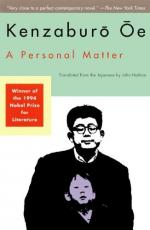
When Bird [protagonist of A Personal Matter] makes his final choice [to reject an adventurous life in favor of tedious domesticity], he is fulfilling, not [an] imported nineteenth-century romanticism, but an attitude native to Japan for almost as many centuries as [Westerners] have taken the attitude that action is intrinsically good, that rebellion is under a number of circumstances virtuous, particularly if it allegedly gives greater individual freedom, that fighting to the death against insurmountable odds carries with it its own honor. Bird and Ōe reject these convictions. Japan has a long tradition of accepting the inevitable which, in the West, is called resignation, which like "derivative," is an earnestly prejudicial term. For the Japanese, to assume the responsibilities imposed upon one by one's superiors, by filial piety and the like, is an act of virtue. To maintain existent orders is preferable to change, and certainly the subjugation of the individual to a wide structure of relationships and responsibilities is considered right and honorable. Meeting demands and fulfilling obligations are required. Bird, therefore, is commendable in his actions from a Japanese perspective. By doing all the wrong things from a western point of view, he succeeds from a Japanese point of view by making the hard decision to stay within his social structure. The decision is for him the hard way and not, as with us, the easy.
The Japanese ability to settle for less than the ideal, not even to hope for some platonic ideal, seems to occidentals a seditious doctrine. Nurtured on striving for perfection (or at least progress) we are disarmed by a character who does not ask for much, who decides that the best solution is to learn to live with things as they are, to make do, hopefully, but not grandiosely. Our reflexes reject the man who decides to give in, not to struggle. Such cowardice is discomfitting, particularly when he seems pleased with his decision. In the West, we accept resignation as a solution only when it carries with it total despair. A more or less cheerful acceptance of circumstances is beyond our comprehension. We are in sympathy with Bird as he is frantic, anomic, behaving outrageously, but when he behaves reasonably, we condemn him and his creator. (pp. 50-1)
This is a free excerpt of 375 words. There are 466 words (approx.
2 pages at 300 words per page) in the full critical essay.
Read the rest of this Criticism with our Ōe, Kenzaburō 1935–: Critical Essay by Wayne Falke Access Pass.

