
 Print
Print Word
Word PDF
PDF|
This section contains 1,936 words (approx. 7 pages at 300 words per page) |

|
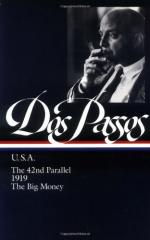
John Dos Passos records and resists in U.S.A. the extinction of the private voice, the invasion of the private space, by the devastating forces of history. The landscapes of the test, like those of Three Soldiers and Manhattan Transfer, are strewn with that devastation's debris—the residue of character, the remains of narrative. Dos Passos chronicles in the trilogy the voices and the acts of residual men—the echoes, the fragments that compose America.
U.S.A. expands the themes and techniques of Three Soldiers and Manhattan Transfer. Structurally it is even more artificial and patterned. The usual criterion of realistic style, that it vanishes before the reality of the subject, does not apply to its pages. As in Manhattan Transfer Dos Passos deforms the voices of America, the bankrupt speech of anonymous men…. U.S.A. is not a recording of America. And it is...
|
This section contains 1,936 words (approx. 7 pages at 300 words per page) |
|



