
BookRags.com Literature Guides Literature
Guides
Criticism & Essays Criticism &
Essays
Questions & Answers Questions &
Answers
Lesson Plans Lesson
Plans
My Bibliography Periodic Table U.S. Presidents Shakespeare Sonnet Shake-Up
Research Anything:        
History | Encyclopedias | Films | News | Create a Bibliography | More... Login | Register | Help


Davie, Donald (Alfred) 1922–: Critical Essay by John Lucas

Print-Friendly  Order the PDF version  Order the RTF version
About 2 pages (447 words)
Donald Davie Summary

Bookmark and Share Questions on this topic? Just ask!

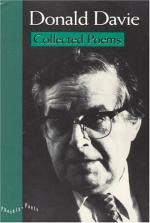
If poems were made solely of ideas there would be few more interesting poets than Donald Davie. For his seriousness about ideas is never in doubt: he ponders, questions, argues with himself and others, and it seems inevitable that, reading him, you want to argue back. Davie's [Collected Poems 1970–1983] is, in short, remarkable for its prose virtues, although these have more to do with articulate energy than with purity of diction. For he can be very clumsy and his ear is by no means true. This is especially the case whenever he tries to move towards the colloquial or the demotic. It is not merely that his lines lack grace, or that they quite fail to suggest an attentiveness to those rhythms that imply human depths tapped through speech utterance. It is also that although he requires us to be good listeners he is not a good listener himself. This is perhaps a consequence of his donnishness, of a literariness that seems ill at ease with the familiar. At all events there are some remarkably phoney moments in his poetry. 'The beery ram that mounted / His niece and, hissing "Belt up", had her.' How do you hiss 'Belt up'? And can you really believe in the desire of a poet to make it new who writes of 'a hulking great villain' or who carelessly repeats 'there's' 'theirs' and 'there's' in the space of three lines?

Well, yes, you can. Because set against these faults, and in spite of a lack of canorousness so great that trying to speak his lines you often feel as though you have a mouth full of pebbles, there are those undeniable merits that keep you reading. In fact, Davie is very readable, perhaps because his literary, donnish qualities compel him to take the reader seriously, so that although you often feel talked at you never feel talked down to. I do not intend this to be faint praise. There are not many poets who can communicate such passionate interest in the written word or who can match Davie's searching out of a variety of frequently surprising verse forms and prosodic techniques, all of which he puts to exhilarating use. At his best Davie is an ambassador for poetry and, whether abrasive or courteous, always candid, open, vulnerable even. Of the poems new to me in this collection I particularly admire 'Artifax in Extremis', 'Well-Found Poem' and 'Catullus on Friendship', with its inimitable, rasping, half-affectionate, half-maddened tone, its very real testimony to the exactions required by a marriage of minds.

This is a free excerpt of 425 words. There are 447 words (approx. 1 page at 300 words per page) in the full critical essay.

Read the rest of this Criticism with our Davie, Donald (Alfred) 1922–: Critical Essay by John Lucas Access Pass.

Ask any question on Donald Davie and get it answered FAST!
Answer questions in BookRags Q&A and earn points toward
discounted or even FREE Study Guides and other BookRags products!
Learn more about BookRags Q&A
Copyrights
Davie, Donald (Alfred) 1922–: Critical Essay by John Lucas from Literature Criticism Series. ©2005-2006 Thomson Gale, a part of the Thomson Corporation. All rights reserved.

Join BookRagslearn moreJoin BookRags


About BookRags | Customer Service | Report an Error | Terms of Use | Privacy Policy

