
 Print
Print Word
Word PDF
PDF|
This section contains 1,058 words (approx. 4 pages at 300 words per page) |

|
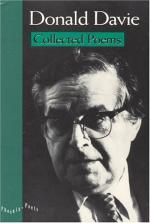
[Davie's Collected Poems, 1950–1970] shows that Davie soon moved on from the quasi-Augustan formality he had cultivated in the fifties, and since then has written in many styles and been open to a wide range of poetic influences, mostly American and Continental European. (p. 345)
[That Davie is an interesting writer] arises less from the character of Davie's poems, taken separately, than from the total impression one gets from all his writing of a powerful literary personality struggling with obsessions and endeavoring, with unexpected success, to balance or combine attitudes usually thought of as contradictory. Thus, Davie is emphatically a moralist, imbued with the rigorous spirit of the Cambridge English school of the forties and fifties. His first critical book, Purity of Diction in English Verse (1952), found admirable moral qualities in the lexical restraint and controlled syntax of eighteenth-century poetry and was offered as a lesson in the neoclassical virtues...
|
This section contains 1,058 words (approx. 4 pages at 300 words per page) |
|



