
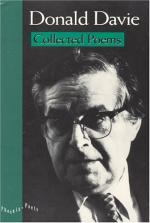
Of all the first-rate poets of the age, Donald Davie is the most notably reactionary. If only with some strain, we might see him, to advantage, as mining in the great ascetic vein of contemporary art, where the classical spirit thins away—as in Rothko, Bresson, Sarraute, Beckett, Cage—in ever starker forms. And yet Davie stands far to the right of most of his fellow ascetics—indeed, within hailing distance of the eighteenth century. In tone, diction, and verse form, he often recalls the late Augustan poets, of whom he has written well and whom he has also anthologised. Above all he has tried, like the Augustans, to be urbane: to voice (in words he quotes from Matthew Arnold) "the tone and spirit of the center." This is reactionary indeed. For of course there is no longer any center. Or the center is but a maelstrom, a contention. (p. 66)
[It] is just the poet's voice, and only this, that we hear speaking in Davie's poetry. It could not be otherwise. "To make poetry out of moral commonplace," Davie notes, "a poet has to make it clear that he speaks not in his own voice (that would be impertinent) but as the spokesman of a social tradition."… [To] "make poetry out of moral commonplace," as Davie tries to do, when the commonplace itself seems damaged, indeed marooned—indeed, forlorn—does require something like impertinence; and rapping on roving knuckles with yardsticks borrowed from old classrooms, impertinently using the word "impertinence" with its haughty assumption of determinate absolutes, what Davie himself exemplifies, we may feel, is not "the tone and spirit" of any center, but something more courageous and significant, not to say lonely: the individual man working out the necessities of his conscience. Moreover, what really fires this conscience, we may feel, is not at all being at the center, whatever that may happen to be in any age, but being right: right about the need for civilized restraint, for faith in the idea of civilization itself. We hear in Davie's poetry a voice that will speak out in spite of its knowledge of the indifference or incredulity that awaits it—a voice consciously coming, not from the center of contemporary culture, but from out on the edge, in a kind of nagging nostalgia for an austerer day, when men lived and died by Nonconformist lights, or for Reason, Loyalty, Restraint, the Right. It is the voice of a conscience that—protestingly—finds itself left behind.
This is a free excerpt of 408 words. There are 3,011 words (approx.
10 pages at 300 words per page) in the full critical essay.
Read the rest of this Criticism with our Davie, Donald 1922–: Critical Essay by Calvin Bedient Access Pass.

