
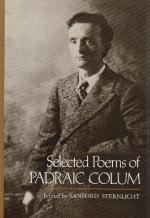
Those who have followed the work of Padraic Colum from its beginnings in "Wild Earth" have always looked forward to the novel which one felt he could and would write. That anticipation is not disappointed in "Castle Conquer." In spite of the years that have slipped by since he gave us that first book of poems, since "The Land," "The Fiddler's House," and "Thomas Muskerry" established him in an unassailable position in the Irish Theater, this book betrays nothing of the changed life, the varied activities that have since been his. "Castle Conquer" belongs to the period preceding his hegira, and the perfume of Irish earth clings about it as unmistakably as it breathed out of every page of his early plays and poems. This prose has all the simple charm, the fresh tang that made the poetry of "Wild Earth" irresistible.
The story centers about Francis Gillick, the returned student from the Irish College in Salamanca, who has given up his studies for the priesthood and come to settle down among his own people. As a "spoilt priest" he is too greatly handicapped in the immediate circle of his own friends and relatives, so he goes to another part of the country to work on the farm of Honor Paralon, whose daughters Oona and Brighid befriend him, until inevitably both girls are more deeply involved by their affections than mere friendship. It is to Brighid that Francis pledges himself, and their love is drawn by the author in scenes of a whispered and passionate intensity which contrast curiously with the mawkish sentimentality, on the one hand, and the pathological realism, on the other, which are an essential feature of the average novel of today. In the relations of these two there is a tender shyness, charmingly rendered, which is as characteristic, in its way, as the brutalities of James Joyce, who, too, has described one phase of the Irish attitude in matters of sex. But Colum shows how this idyll, like so many other normal human impulses, is overshadowed in Ireland by the figure of Kathleen ni Houlihan, into whose mouth W. B. Yeats has put words that are not forgotten: "It is hard service they take that help me. Many that are red-cheeked now will be pale-cheeked; many that have been free to walk the hills and the bogs and the rushes will be sent to walk hard streets in far countries … and for all that they will think they are well paid."
This is a free excerpt of 415 words. There are 773 words (approx.
3 pages at 300 words per page) in the full critical essay.
Read the rest of this Criticism with our Colum, Padraic 1881–1972: Critical Essay by Ernest Boyd Access Pass.

