
BookRags.com Literature Guides Literature
Guides
Criticism & Essays Criticism &
Essays
Questions & Answers Questions &
Answers
Lesson Plans Lesson
Plans
My Bibliography Periodic Table U.S. Presidents Shakespeare Sonnet Shake-Up
Research Anything:        
History | Encyclopedias | Films | News | Create a Bibliography | More... Login | Register | Help


Christie, Agatha 1890–1976: Critical Essay by Howard Haycraft

Print-Friendly  Order the PDF version  Order the RTF version
Agatha Christie
About 2 pages (583 words)
The Murder of Roger Ackroyd Summary

Bookmark and Share Know this topic well? Help others and get FREE products!

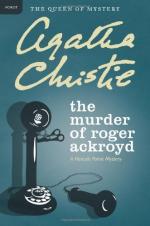
Of the impressive list of [Mrs. Christie's] volumes, mostly about Poirot,… the best known and most widely discussed is the brilliant The Murder of Roger Ackroyd…. At the present late date it is betraying no secret to say that this remarkable story, a tour de force in every sense of the word and one of the true classics of the literature, turns on the ultimate revelation of the narrator as the criminal. This device (or trick, as the reader may prefer) provoked the most violent debate in detective story history. Scarcely had the ink dried on the pages before representatives of one school of thought were crying, "Foul play!" Other readers and critics rallied as ardently to Mrs. Christie's defense, chanting the dictum: "It is the reader's business to suspect every one." The question remains unsettled to-day, and the inconclusive argument will probably continue as long as detective stories are read and discussed. (p. 130)

Happily, Poirot richly merited the attention he [has] received. For when he is at the top of his form few fictional sleuths can surpass the amazing little Belgian—with his waxed mustaches and egg-shaped head, his inflated confidence in the infallibility of his "little grey cells," his murderous attacks on the English language—either for individuality or ingenuity. His methods, as the mention of the seldom-forgotten "cells" implies, are imaginative rather than routine. Not for Poirot the fingerprint or the cigar ash. His picturesque refusal to go to Holmes-like on all fours in pursuit of clues is classic in the literature. (But his inventor does not scorn to employ one of the tritest of the Conanical devices almost ad nauseam, in the person of Captain Hastings, easily the stupidest of all modern Watsons.) Not quite an arm-chair detective, Poirot nevertheless spurns the aid of science. He is the champion of theory over matter. What this postulate may lack in verisimilitude it gains in dramatic possibilities, which the author knows well how to exploit to advantage.

This is a free excerpt of 327 words. There are 583 words (approx. 2 pages at 300 words per page) in the full critical essay.

Read the rest of this Criticism with our Christie, Agatha 1890–1976: Critical Essay by Howard Haycraft Access Pass.

Ask any question on The Murder of Roger Ackroyd and get it answered FAST!
Answer questions in BookRags Q&A and earn points toward
discounted or even FREE Study Guides and other BookRags products!
Learn more about BookRags Q&A
Copyrights
Christie, Agatha 1890–1976: Critical Essay by Howard Haycraft from Literature Criticism Series. ©2005-2006 Thomson Gale, a part of the Thomson Corporation. All rights reserved.


Join BookRagslearn moreJoin BookRags


About BookRags | Customer Service | Report an Error | Terms of Use | Privacy Policy

