
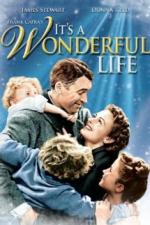
One important function of good art or entertainment is to unite and illuminate the heart and the mind, to cause each to learn from, and to enhance, the experience of the other. Bad art and entertainment misinform and disunite them. Much too often ["It's a Wonderful Life"] appeals to the heart at the expense of the mind; at other times it urgently demands of the heart that it treat with contempt the mind's efforts to keep its integrity; at still other times the heart is simply used, on the mind, as a truncheon. ["It's a Wonderful Life"] does all this so proficiently, and with so much genuine warmth, that I wasn't able to get reasonably straight about it for quite a while. I still think it has a good deal of charm and quality, enough natural talent involved in it to make ten pictures ten times as good, and terrific vitality or, rather, vigor—for much of the vitality seems cooked-up and applied rather than innate. (The high-school dance floor coming apart over a swimming pool is a sample of cooking-up that no movie has beaten for a long time.) But I mistrust, for instance, any work which tries to persuade me—or rather, which assumes that I assume—that there is so much good in nearly all the worst of us that all it needs is a proper chance and example, to take complete control. I mistrust even more deeply the assumption, so comfortably stylish these days, that whether people turn out well or ill depends overwhelmingly on outside circumstances and scarcely if at all on their own moral intelligence and courage. Neither idea is explicit in this movie, but the whole story depends on the strong implication and assumption of both….
Yet at its best, which is usually inextricable with its worst, I feel that this movie is a very taking sermon about the feasibility of a kind of Christian semi-socialism, a society founded on affection, kindliness, and trust, and that its chief mistake or sin—an enormous one—is its refusal to face the fact that evil is intrinsic in each individual, and that no man may deliver his brother, or make agreement unto God for him. It interests me, by the way, that in representing a twentieth-century American town Frank Capra uses so little of the twentieth and idealizes so much that seems essentially nineteenth-century, or prior anyhow to the First World War, which really ended that century. Many small towns are, to be sure, "backward" in that generally more likable way, but I have never seen one so Norman-Rockwellish as all that. (p. 193)
James Agee, "Books and the Arts: 'It's a Wonderful Life'," in The Nation (copyright 1947 The Nation Associates, Inc.), Vol. 164, No. 7, February 15, 1947, pp. 193-94.
This is a free excerpt of 461 words. There are 465 words (approx.
2 pages at 300 words per page) in the full critical essay.
Read the rest of this Criticism with our Capra, Frank 1897–: Critical Essay by James Agee Access Pass.

