
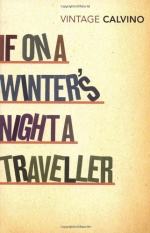
Like a play within a play, Calvino's [Se una notte d'inverno un viaggiatore] is both double and dual. Eleven chapters and ten incipits, the beginnings of as many unrelated, interrupted "novels," form one whole. The frame story is about nothing less than "ce vice impuni, la lecture," the pleasure of vicarious experience or of escape offered by the printed page and the many circumstances that contribute to it or stand in its way. In the early chapters we get an almost complete phenomenology of the book as artifact and text as we follow the Reader—the "tu" familiarly addressed by the author—in his acquisition of the book, his settling down to read it, his search for an undamaged copy to take the place of the one with missing pages that has been sold him: a pursuit which takes him to university library and publishing house and leads to his encounter with other readers, from the voracious, instinctive and uncritical Ludmila to her sister, the programmed reading machine Lotaria.
The frame story loses some of its impetus—that wonderful involvement of all readers conscious of their being readers, so similar to that of the theatre audience that sees itself reflected in the fictional audience onstage—when the writer Silas Flannery appears. He is a plagiarist or counterfeiter, suffering from writer's block and obsessed by the identity of a woman he sees stretched out on a deck chair reading miles away below his Alpine refuge. As attention is focused more and more on the writer's point of view of the writer/reader relationship, the freshness of the early pages is lost in what to me at least seem unnecessary complications. The frame story ends twice, once with a roundtable discussion between occasional companions in a library, the second with the Reader and Ludmilla married, each reading his/her book in the large double bed. The first resolution contains one kind of climax or denouement in the surprise ending which reveals the beginning of yet another novel, the eleventh, in the continuous sentence formed by the ten titles of the broken-off texts. The denouement of the second ending is the more familiar one: in its reference to the fundamental pattern of storytelling, "And they lived happily ever after," it contains the reassurance that life too will go on.
This is a free excerpt of 379 words. There are 513 words (approx.
2 pages at 300 words per page) in the full critical essay.
Read the rest of this Criticism with our Calvino, Italo 1923–: Critical Essay by Olga Ragusa Access Pass.

