
 Print
Print Word
Word PDF
PDF|
This section contains 1,456 words (approx. 5 pages at 300 words per page) |

|
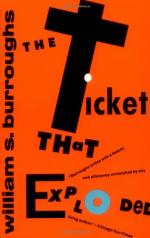
In the main Burroughs is faithful to [the theme he expressed in both The Ticket That Exploded and Nova Express]: a coalition of three life-forms infiltrated Earth three thousand years ago, after ruining another planet. Their strategy is to take advantage of human weaknesses and conflicts, exacerbate them and feed on the energy thus released. The soft spots manipulated by these alien agents disguised as human beings (the nova mob), are sex, drugs and power; in this we see Burroughs' obsessions take shape. The Venus Vegetable People crave sex energies, the Uranian Heavy Metal People drugs, and the Minraud Insect People control….
[The three-fold plot is] nowhere to be found in straightforward linear form. The reader must piece [the story lines] together from flashes, obsessive phrases, and incomplete scenes, struggling through disjointed chronology and abrupt changes of narrators, or cryptic cut-ups. The difficulty and sophistication of the narrative...
|
This section contains 1,456 words (approx. 5 pages at 300 words per page) |
|



