
 Print
Print Word
Word PDF
PDF|
This section contains 200 words (approx. 1 page at 300 words per page) |

|
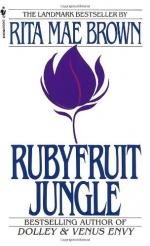
"Rubyfruit Jungle" is basically a breathless rush through some of the primary colors of the English language to tell the story of Molly Bolt: born female, gay, illegitimate, poor, unloved, and white trash—but with enough courage, humor, and grit to get her from nowhere ("flatlands full of sandspurs, lizards, and cockroaches …") to everywhere ("One way or another … I'm going to be the hottest 50-year-old this side of the Mississippi")….
Although much of Molly's world seems a cardboard stage-set lighted to reveal only Molly's virtues and those characteristics which mark her as the "exceptional" lesbian, only peripherally united with the routine hardship of ordinary dyke life, it is exactly this quality of "Rubyfruit Jungle" which makes it exemplary (for women) of its kind: an American primitive, whose predecessors have dealt only with male heroes. Although Molly Bolt is not a real woman, she is at least the first...
|
This section contains 200 words (approx. 1 page at 300 words per page) |
|



