
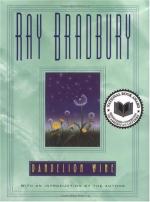
[Dandelion Wine] has no more reason to end than it has to begin. Its cause and effect relationship is a spontaneous one, for which A leads to B, and Z again to A. It is a brief glimpse on a crowded street of a stranger one can never forget and always love. It has the drug color vividness of black and white photography, giving the honest shade and contrast of face stories at moments removed from motion, from time, from definition. But, in the same breath, it has a prescribed structure, with Douglas, his brother Tom, his friends, his senses, all acting under the assumed reality which the freedom of fantasy offers. Dandelion Wine is fantasy, in the most boundless sense of the word. It is the fantasy which is always at hand, known to us all—not the thirty-five cents a copy world of escapism and plasticity, but the unrigid, free, real world of the mind's expectations. Though one may not have logical inference patterns to make, conflicts to resolve, or character types to establish, there is a single, though all encompassing direction, a "place" to go, an exercise to perform. In effect, this unavoidable and necessary element of imposition requires expansion, and passionate devotion to this mental growth. When Bradbury sets his stage, much like a theatre director, an animated world appears in which the facts of the imagination become as acceptable as the facts of reality. (p. 161)
Bradbury proves his fantasy by this reaching through the senses, this creating of real life. We believe, really believe, only that which is proven artistically, employing both the aesthetic criticism of the intellect and the senses. Only the latter is nearly infallible, as the virgin innocence of sensual intuition either refuses to accept or trustingly incorporates the devil deceptions of illusion's mists…. To write successful fantasy, to employ successful imagination, elements of the real world must be among the constituent ingredients of the mental exercise. Only then can the mind feel secure in its journey. (pp. 162-63)
This is a free excerpt of 336 words. There are 949 words (approx.
3 pages at 300 words per page) in the full critical essay.
Read the rest of this Criticism with our Bradbury, Ray 1920–: Critical Essay by Tom Bradford Access Pass.

