
BookRags.com Literature Guides Literature
Guides
Criticism & Essays Criticism &
Essays
Questions & Answers Questions &
Answers
Lesson Plans Lesson
Plans
My Bibliography Periodic Table U.S. Presidents Shakespeare Sonnet Shake-Up
Research Anything:        
History | Encyclopedias | Films | News | Create a Bibliography | More... Login | Register | Help

Not What You Meant?  There are 4 definitions for A Man for All Seasons.

Bolt, Robert 1924–: Critical Essay by Robert W. Corrigan

Print-Friendly  Order the PDF version  Order the RTF version
Robert Bolt
About 2 pages (635 words)
A Man for All Seasons Summary

Bookmark and Share Questions on this topic? Just ask!

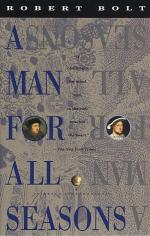
[A Man for All Seasons] is one of the finest achievements of the modern theatre, and one of the great dramas of selfhood of all time. (pp. 27-8)

Bolt sees all too clearly the effects collectivism have had upon the individual. In his preface he describes how in our time we have lost all conception of ourselves as individual men, and as a result we have increasingly come to see ourselves in the third person. As this happens we are less and less able to deal with life's psychic, social, and spiritual collisions. Thomas More does not see himself in this way; he is "a man with an adamantine sense of his own self. He knew where he began and left off," and the action of the play is best described as a series of collisions between More and a group of powerful and able men who would have him deny his selfhood to serve the wishes of his king. (p. 28)

This is a free excerpt of 161 words. There are 635 words (approx. 2 pages at 300 words per page) in the full critical essay.

Read the rest of this Criticism with our Bolt, Robert 1924–: Critical Essay by Robert W. Corrigan Access Pass.

Ask any question on A Man for All Seasons and get it answered FAST!
Answer questions in BookRags Q&A and earn points toward
discounted or even FREE Study Guides and other BookRags products!
Learn more about BookRags Q&A
Copyrights
Bolt, Robert 1924–: Critical Essay by Robert W. Corrigan from Literature Criticism Series. ©2005-2006 Thomson Gale, a part of the Thomson Corporation. All rights reserved.

Join BookRagslearn moreJoin BookRags


About BookRags | Customer Service | Report an Error | Terms of Use | Privacy Policy

