
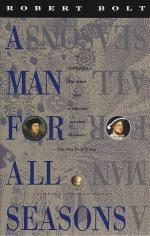
Bolt's Sir Thomas More [in A Man for All Seasons] is an intellectual blessed with common sense and cursed with a conscience. He is witty, charming, and wise, and not especially eager to add to these the supererogatory virtue of heroism. His unshakable belief in Catholicism is coupled with an almost equal faith in the law …, which will protect his conscience provided it has the good sense of not going naked to its enemy. He is as loyal a minister to Henry as superior intelligence will permit, as good a husband and father as a man who lives most warmly with ideas can be, and surely the unworldliest man of the world. The play shows how this upright and religiously orthodox man, who cannot agree to Henry's remarriage and England's consequent divorce from the Church of Rome, is hounded into heroism. When no amount of prudence and legal ingenuity can shelter him from the ever fouler machinations of his enemies, he finally meets the tragic greatness thrust upon him with the spiritual and verbal grandeur of a Socrates. It must be admitted that Mr. Bolt, though relying scrupulously on documentation and even quotation from More's own words, has somewhat idealized his hero—the acrimonious religious polemist who helped bring about the death sentence of a mere translator of the Bible into English is certainly not present—but he has given us a believable, unwhittled-down Sir Thomas, and who could ask for More?
The play does have its limitations. It is, by the very nature of being a "history," forced to look at things a little more panoramically than profoundly. Bolt does his best to compress the variousness and proliferation of history into a few typical, clearly defined figures and situations, but he is still not quite successful in making most of his characters anything but accessories before the fact of the protagonist. Nor is this protagonist all that one might desire. Heroism, indeed martyrdom, out of doctrinal differences in religion may still be moving from our point of view, but it does not carry the urgency of self-sacrifice for some other, socially more compelling, cause. True, we can translate, and are encouraged to do so, More's struggle into certain contests of our time, but it is like translating out of the Chinese into English: the gap between the cultures and languages is too great to permit more than estimable approximation. Added to this is the fact that More had no adversary worthy of his talents: Henry VIII had nothing but his despotism, Cromwell only his low cunning and unscrupulousness, and the others not even that. There is no good chance, therefore, for a clash with real dramatic thunder and blazing intellectual lightning. There are, in fact, the very limitations of the hero's unfleshly, cerebral middle age.
This is a free excerpt of 464 words. There are 591 words (approx.
2 pages at 300 words per page) in the full critical essay.
Read the rest of this Criticism with our Bolt, Robert 1924–: Critical Essay by John Simon Access Pass.

