
BookRags.com Literature Guides Literature
Guides
Criticism & Essays Criticism &
Essays
Questions & Answers Questions &
Answers
Lesson Plans Lesson
Plans
My Bibliography Periodic Table U.S. Presidents Shakespeare Sonnet Shake-Up
Research Anything:        
History | Encyclopedias | Films | News | Create a Bibliography | More... Login | Register | Help


Böll, Heinrich (Theodor) 1917–: Critical Essay by Frank J. Warnke

Print-Friendly  Order the PDF version  Order the RTF version
Heinrich Boll
About 3 pages (946 words)
The Clown Summary

Bookmark and Share Know this topic well? Help others and get FREE products!

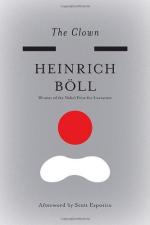
It is wrong-headed to read The Clown as a simple condemnation of German national character, or to find in its wistful hero that mythical figure so dear to our own uneasy sense of virtue—the Good German Intellectual castigating his vicious and hypocritical countrymen. Vice and hypocrisy are the subjects of the book, satiric castigation is its mode, and the twilight of the Nazi era sounds a sinister ground-bass in the memory of the narrator-protagonist, but neither ex-Nazis nor neo-Nazis are conspicuous in the contemporary Rhineland of the clown Hans Schnier. Drinking excessively and in a decline because his Catholic mistress has left him to marry a prominent Catholic layman, he telephones the entire range of his acquaintance in Bonn—ostensibly to borrow money and to locate Marie, but actually to operate as a kind of scourge of villainy, to force his interlocutors to come to an awareness of their true selves and thus to measure those selves against the clear moral imperatives which, the novel implies, only a clown can fully perceive.

A clean record in the bad old days is no guarantee of moral purity, although two of the least savory figures in Böll's gallery were passionate followers of the Führer. The execrable Herbert Kalick, one-time Hitler Youth leader who had menaced the child Hans in the closing days of the war, has become a sentimental democrat, fond of talking about "Jewish spirituality," but the truly appalling thing is that his conversion is perfectly sincere: he is, as Schnier observes, "a born conformist." And Schnier's unspeakable mother, a fervent Blut und Boden patriot in the old days, is now active in the "Executive Committee of the Societies for the Reconciliation of Racial Differences." But other characters, with less compromised political pasts, come under as severe attack from the clown, to whom the facile doctrine of collective guilt is quite meaningless…. Individual guilt, his experience with the virtuous pillars of society would suggest, is quite sufficient to make recourse to abstractions unnecessary.

This is a free excerpt of 330 words. There are 946 words (approx. 3 pages at 300 words per page) in the full critical essay.

Read the rest of this Criticism with our Böll, Heinrich (Theodor) 1917–: Critical Essay by Frank J. Warnke Access Pass.

Ask any question on The Clown and get it answered FAST!
Answer questions in BookRags Q&A and earn points toward
discounted or even FREE Study Guides and other BookRags products!
Learn more about BookRags Q&A
Copyrights
Böll, Heinrich (Theodor) 1917–: Critical Essay by Frank J. Warnke from Literature Criticism Series. ©2005-2006 Thomson Gale, a part of the Thomson Corporation. All rights reserved.


Join BookRagslearn moreJoin BookRags


About BookRags | Customer Service | Report an Error | Terms of Use | Privacy Policy

