
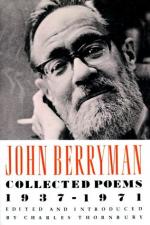
As he was transforming himself from an imitative young poet into the inimitable later fantasist of the "Dream Songs," Berryman was developing a comparable critical style that was provocative, erudite and humorous. His nearest counterpart was Randall Jarrell, a poet-critic with whom he had much in common, including the lamentable suicide; and it may be said of both writers that their wit was costly, since it placed them at a measurable distance above most of their contemporaries and may have contributed to their sense of desperation. But there is no desperation [in The Freedom of the Poet], and in fact the collection shows all the best sides of Berryman and little of his worst. As a critic, Berryman can be enjoyed for the sheer pleasure of his discoveries, often made in the reading of very familiar authors. Perhaps his most original piece of criticism is on "Shakespeare at Thirty," a tour de force in which, by looking closely at the earliest works, he brings Shakespeare to life as a young man starting out on the greatest of literary careers. Not only does Berryman achieve a remarkable identity with the mind of Shakespeare, but he does equally well with modern poets as different as Stephen Crane and Ezra Pound, establishing the wide range of his critical sympathies.
Good at throwing new light on accepted authors, he can also be illuminating about minor authors, especially in essays on "The Monk and its Author" and on "Thomas Nashe and The Unfortunate Traveler," and he provides some excellent examples of literary exegesis in short pieces on Hemingway's "A Clean, Well-Lighted Place," on "The Sorrows of Captain Carpenter" and on "Prufrock's Dilemma." He plunges off the deep end of symbolic interpretation only once, in a highly Freudian reading of Conrad's Heart of Darkness; but even in the midst of murky speculations about sexual innuendo he can flash forth with a memorable aside about his own motives for criticism:
This is a free excerpt of 322 words. There are 425 words (approx.
1 page at 300 words per page) in the full critical essay.
Read the rest of this Criticism with our Berryman, John 1914–1972: Critical Essay by William Pratt Access Pass.

