
 Print
Print Word
Word PDF
PDF|
This section contains 204 words (approx. 1 page at 300 words per page) |

|
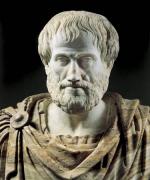
Born in the Ionian colony of Stagira in Macedonia, Aristotle lost his parents at an early age. Little is known about them, but scholars have recorded that his father, Nicomachus, served as the court physician to the King of Macedon. When Aristotle was seventeen, his guardian sent him to study in Athens, under Plato. Aristotle spent twenty years at the Academy and left after Plato's death in 347 B.C. After a period of travel, Aristotle married Pythias, with whom he had a daughter and probably a son, Nicomachus. In 342, Aristotle was appointed tutor to Philip II's thirteen-year-old son, Alexander (later known as Alexander the Great). After remaining in the Macedonian court at Pella for some time, Aristotle probably retired to Stagira in 340, when Alexander became his father's regent. Not long after, in 335, Aristotle returned to Athens and founded a school, the Lyceum. Here, Aristotle lectured, conducted research, and...
|
This section contains 204 words (approx. 1 page at 300 words per page) |
|



