
 Print
Print Word
Word PDF
PDF|
This section contains 250 words (approx. 1 page at 300 words per page) |

|
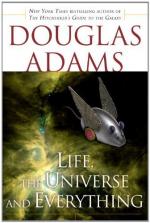
Whimsy is currently in short supply, a deficiency that makes Douglas Adams' new book all the more welcome. Life, the Universe and Everything … is like nothing ever published before except, perhaps, The Hitchhiker's Guide to the Galaxy, also written by Douglas Adams. Once again the protagonist is a reluctant wanderer named Arthur Dent; once again his intergalactic guide is an extraterrestrial named Ford Prefect. Vooming around the void accompanied by a two-headed, three-armed creature who once controlled the universe and a sexy space cadet, Dent manages to avert Armageddon and save the world for life as we never knew it. Adams delights in cosmic pratfalls, and if he sometimes loses track of his narrative, he more than makes up for it by confirming what many have suspected all along: "He learned to communicate with birds and discovered that their conversation was fantastically boring. It was all to do...
|
This section contains 250 words (approx. 1 page at 300 words per page) |
|



