
BookRags.com Literature Guides Literature
Guides
Criticism & Essays Criticism &
Essays
Questions & Answers Questions &
Answers
Lesson Plans Lesson
Plans
My Bibliography Periodic Table U.S. Presidents Shakespeare Sonnet Shake-Up
Research Anything:        
History | Encyclopedias | Films | News | Create a Bibliography | More... Login | Register | Help

Not What You Meant?  There are 7 definitions for Things Fall Apart.

Achebe, Chinua 1930–: Critical Essay by Bruce King

Print-Friendly  Order the PDF version  Order the RTF version
Chinua Achebe
About 8 pages (2,472 words)
Things Fall Apart Summary

Bookmark and Share Questions on this topic? Just ask!

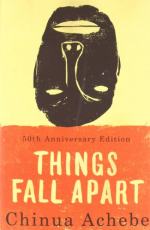
With the publication of Things Fall Apart (1958) Nigeria had the classic book that would serve as a point of reference and comparison for future writing. The novel was not only more competent than anything that had preceded it, but it also introduced techniques that liberated future African novelists from having to imitate the conventions of a western literary genre. The omniscient narrator of the opening paragraphs is representative of the voice of the community and introduces the story with simple, somewhat repetitive sentences in an approximation of a story-teller, thus associating the novel with Igbo traditional oral literature. In contrast to the literary device of a first-person narrator which makes us see events through the eyes of the individual speaker, Achebe's narrator makes us part of the awareness and vision of a small, apparently self-enclosed community of nine villages. We are immediately introduced to the traditions of the community, its history and myths, its arts and crafts…. (p. 65)

The apparent simplicity of [the opening] passage is deceptive. It is artistry of a radically different order from those … who later tried to write novels of village life limited to repetition and simple sentences. Achebe's purpose is to situate the reader within a community governed by a rich tribal culture which, being a living culture, is undergoing changes, and the continuity of which will be challenged by the intrusions of Christianity and the white man. If his purpose is to show the dignity of traditional African culture, his job as a writer is to make the Igbo village as richly textured with manners and mores as any local community in the novels of Jane Austen or George Eliot. Indeed Achebe's Igbo village novels resemble those of Eliot or Thomas Hardy in showing the tragedy of individuals resulting from the clash between their own strength of character and the unstoppable forces of historical change. Achebe's heroes gain their stature by their excessive virtue in attempting to oppose fate. This is in contrast to the rest of the village community, which changes its ways under pressure and which may be said to illustrate the importance of communal survival in Africa. The rigidity with which Okonkwo upholds traditional values makes him heroic, but such excesses bring self-destruction because temperance and the ability to accept change are necessary with the coming of the powerful Europeans.

This is a free excerpt of 391 words. There are 2,472 words (approx. 8 pages at 300 words per page) in the full critical essay.

Read the rest of this Criticism with our Achebe, Chinua 1930–: Critical Essay by Bruce King Access Pass.

View all | View only answered questions | View only unanswered questions
Okonkwo's father is sometimes held responsible for his own action, while at other times he is referred to as a "victim" of evil fortune.Do you think Okonkwo and Achebe believes its true?
10

What Points Mean

The best answer to this question will earn 10 points. All other answers will earn 1 point. Click for more information.
In Biographies | Asked by tweak2 | 0 answers | Open for 5 more days
Asked from the Things Fall Apart study pack
(1 question)
Ask any question on Things Fall Apart and get it answered FAST!
Answer questions in BookRags Q&A and earn points toward
discounted or even FREE Study Guides and other BookRags products!
Learn more about BookRags Q&A
Copyrights
Achebe, Chinua 1930–: Critical Essay by Bruce King from Literature Criticism Series. ©2005-2006 Thomson Gale, a part of the Thomson Corporation. All rights reserved.


Join BookRagslearn moreJoin BookRags


About BookRags | Customer Service | Report an Error | Terms of Use | Privacy Policy

