
BookRags.com Literature Guides Literature Guides Criticism/Essays Criticism/Essays Biographies Biographies My Bibliography Periodic Table U.S. Presidents Shakespeare Sonnet Shake-Up
Research Anything:        
History | Encyclopedias | Films | News | Create a Bibliography | More... Login | Register | Help
Not What You Meant?  There are 14 definitions for Polk County.  Also try: Zora.

Search "Zora Neale Hurston"

Biographies Navigation
 

Zora Neale Hurston Biography

Print-Friendly  Order the PDF version  Order the RTF version
About 2 pages (684 words)
Zora Neale Hurston Summary

Bookmark and Share
Name: Zora Neale Hurston
Birth Date: January 7, 1903
Death Date: January 28, 1960
Place of Birth: Eatonville, Florida, United States
Place of Death: Fort Pierce, Florida, United States
Nationality: American
Ethnicity: African American
Gender: Female
Occupations: author, folklorist

Encyclopedia of World Biography on Zora Neale Hurston

Zora Neale Hurston (1903-1960), folklorist and novelist, was best known for her collection of African American folklore Mules and Men (1935) and her novel Their Eyes Were Watching God (1937), in which she charted a young African American woman's journey for personal fulfillment.

Zora Neale Hurston was born on January 7, 1903, in Eatonville, Florida, to Reverend John and Lucy Hurston. Zora's mother died when she was nine years old, and her father soon remarried. Her relationship with her stepmother rapidly deteriorated, and her father sent her to school in Jacksonville. In her early teens she became a wardrobe girl in a Gilbert and Sullivan repertory company touring the South. Eighteen months later she enrolled in Morgan Academy in Baltimore in 1917. She graduated a year later and went to Howard University, where she completed a year and a half of course work between 1919 and 1924. She secured a scholarship which allowed her to transfer to Barnard College, where she earned her B.A. in 1928. From 1928 to 1932 she studied anthropology and folklore at Columbia University under Franz Boas, the renown anthropologist. In 1936 she was awarded a Guggenheim Fellowship for travelling and collecting folklore in Haiti and the British West Indies.

Hurston worked at a variety of jobs, from manicurist, to Fannie Hurst's secretary, to writer for Paramount and Warner Brothers Studios, to librarian at the Library of Congress, to drama coach at North Carolina College for Negroes. Hurston began her writing career while at Howard when she wrote her first short story for Stylus, a college literary magazine. She continued to write stories, and in 1925 won first prize in the Opportunity literary contest for "Spunk." In 1939 Morgan College awarded her an honorary doctorate. In 1943 she received the Annisfield Award for the autobiographical Dust Tracks on the Road; also in 1943 Howard University bestowed its alumni award upon her.

Although Hurston worked all of her life at many jobs and was a prolific writer, money was always a serious problem. In the late 1940s she returned to Florida and worked as a maid in Riva Alto. After several efforts to rekindle her writing career, she died in poverty in Fort Pierce, Florida.

Hurston's most famous work is her novel Their Eyes Were Watching God (1937), in which she created the portrait of an African American female, Janie, growing into adulthood searching for her identity and fulfillment. Through a series of marriages Janie comes to know and define herself in terms of her relationship with whites. For several years after the novel's publication critics saw this work as a sentimental love story. However, if the novel is read with the understanding that love was the traditional way in which a woman was supposed to find fulfillment, then love can be seen as the vehicle for emotional, spiritual, and intellectual development. The novel also portrays the awakening of a woman's sexuality. With the advent of the women's movement of the 1970s and the subsequent growth of female awareness, many critics cited this novel as the central text in the canon of literature by African American women writers, specifically, and by women writers in general.

Hurston was also a famous folklorist who applied her academic training to collecting African American folklore around her hometown in Florida. This work produced two collections of folklore, Mules and Men (1935) and Tell My Horse (1939). All of her work is characterized by her use of African American folk idioms, which are intrinsic to her character portrayals.

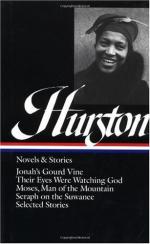
Hurston wrote three other novels: Jonah's Gourd Vine (1934), an autobiographical novel about her father's rise from an illiterate laborer to become a respected Baptist minister; Moses, Man of the Mountain (1939), which recreated Mosaic biblical myth in an African context; and Seraph on the Suwanee (1948), which is about a woman's search for selfhood within the confines of marriage to a man who sees all women as inferior.

Hurston also wrote several plays: Fast and Furious (1931), The First One (1927), Mule Bone: A Comedy of Negro Life in Three Acts (1931), and Polk County (1944), as well as many articles and short stories.

This is the complete article, containing 684 words (approx. 2 pages at 300 words per page).

View More Summaries on Zora Neale Hurston
More Information
  • View Zora Neale Hurston Study Pack
  • 14 Alternative Definitions
  • Search Results for "Zora Neale Hurston"
  • Add This to Your Bibliography
  • More Products on This Subject
    Zora Neale Hurston
    From the 1930s through the 1960s, Zora Neale Hurston was the most prolific and accomplished black w... more

    Zora Neale Hurston
    "Zora was funny, irreverent (she was the first to call the Harlem Renaissance literati the 'niggera... more


    Copyrights
    Zora Neale Hurston from Encyclopedia of World Biography. ©2005-2006 Thomson Gale, a part of the Thomson Corporation. All rights reserved.

    Join BookRagslearn moreJoin BookRags


    About BookRags | Customer Service | Report an Error | Terms of Use | Privacy Policy

