
BookRags.com Literature Guides Literature
Guides
Criticism & Essays Criticism &
Essays
Questions & Answers Questions &
Answers
Lesson Plans Lesson
Plans
My Bibliography Periodic Table U.S. Presidents Shakespeare Sonnet Shake-Up
Research Anything:        
History | Encyclopedias | Films | News | Create a Bibliography | More... Login | Register | Help

Not What You Meant?  There are 15 definitions for Tyndale.

William Tyndale Biography

Print-Friendly  Order the PDF version  Order the RTF version
About 2 pages (571 words)
William Tyndale Summary

Bookmark and Share Know this topic well? Help others and get FREE products!
Name: William Tyndale
Birth Date: c. 1495
Death Date: October 6, 1536
Place of Birth: Gloucestershire, England
Place of Death: Antwerp, Belgium
Nationality: English
Gender: Male
Occupations: biblical scholar, clergyman, translator

Encyclopedia of World Biography on William Tyndale

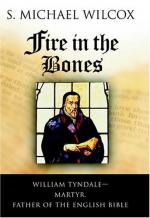
William Tyndale (ca. 1495-1536) was the greatest of all English biblical scholars. His translation of the Bible into English formed the major part of the Authorized Version, or King James Bible.

William Tyndale was born in Gloucestershire and mostly educated at Oxford, where he earned a master of arts degree in 1515. He became a priest and, doubtless influenced among other things by the work of John Colet and Erasmus at Cambridge some years earlier, decided to produce an English translation of the Bible. He found support from a rich London cloth merchant. Within months, however, he became convinced he must leave London if he was to succeed; and, accordingly, with the financial support of the merchant, he left England in 1524, never again to return.

After short sojourns in Hamburg, and, possibly, Wittenberg, Tyndale settled down at Cologne in 1525. He quickly began the printing of his New Testament, but only a few sheets had been finished when the city fathers got wind of it and stopped it. The work was resumed at Worms, and by April 1526 an octavo edition was being sold in London. In November all available copies were burned at St. Paul's Cross. In 1528 Tyndale published the Parable of the Wicked Mammon, dealing with Luther's teaching concerning justification by faith, and the Obedience of a Christian Man, which replaced papal authority by royal authority and was heartily approved by King Henry VIII. However, in the Practice of Prelates in 1530, Tyndale not only attacked Cardinal Wolsey but opposed the annulment of Henry VIII's marriage with Catherine of Aragon. Meanwhile Bishop Tunstall of London had invited Sir Thomas More to reply to Tyndale's books, and a lively controversy took place.

Tyndale's Lutheran-inspired Exposition of the Sermon on the Mount was much admired; and possibly The Supper of the Lord, which appeared in 1533, was also his. Meanwhile throughout these years his work on the Old Testament had been proceeding. In 1530 he published his translation of the Pentateuch. As his New Testament had been pirated for various unsatisfactory editions, he published a revision in 1534, with a third, revised edition in 1535. In 1535, however, he was seized by the local government authorities in Antwerp, where he was living, for being a propagator of heresy. After months of imprisonment and many theological disputations he was condemned in August 1536 for persistence in heresy, and in October he was strangled to death and his body publicly cremated.

During his years at Antwerp, where he was so well maintained by the generosity of the English merchants there, Tyndale acquired a great reputation for austerity of character and frugality of life, combined with a steady attention to the needs of the poor, which offset the impression caused by the violent language found in his polemical works. In the year following his death there appeared in England a new Bible with the king's approval which was said to be the work of one Thomas Matthew. It was, however, a composite work edited by John Rogers and containing translations by him, by Miles Coverdale, and, for the greater part, by Tyndale. This Matthew Bible was reedited by Coverdale and published in 1539. It became known as the Great Bible. In this way Tyndale's translation was the basis of the first Bibles in English to get royal approval. His translation has underlain most subsequent English versions and has profoundly affected the development of the English language.

This is the complete article, containing 571 words (approx. 2 pages at 300 words per page).

View More Summaries on William Tyndale
More Information
  • View William Tyndale Study Pack
  • 15 Alternative Definitions
  • Search Results for "William Tyndale"
  • Add This to Your Bibliography
  • More Products on This Subject
    William Tyndale
    As the first translator of the Bible into modern English, being the first to translate both the ent... more

    Tyndale, William
    TYNDALE, WILLIAM (1494?–1536), Bible translator and Reformation scholar. William Tyndale cam... more


    Ask any question on William Tyndale and get it answered FAST!
    Answer questions in BookRags Q&A and earn points toward
    discounted or even FREE Study Guides and other BookRags products!
    Learn more about BookRags Q&A
    Copyrights
    William Tyndale from Encyclopedia of World Biography. ©2005-2006 Thomson Gale, a part of the Thomson Corporation. All rights reserved.

    Join BookRagslearn moreJoin BookRags


    About BookRags | Customer Service | Report an Error | Terms of Use | Privacy Policy

