 Print
Print Word
Word PDF
PDF|
This section contains 2,552 words (approx. 9 pages at 300 words per page) |

|
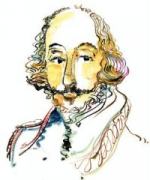
Authors and Artists for Young Adults on William Shakespeare
Considered by critics, scholars, and the theater-going public the most important dramatist in the history of English literature, William Shakespeare occupies a unique position in the pantheon of great world authors. The acknowledged Shakespearean canon of some thirty-seven plays, written in the late sixteenth and early seventeenth centuries, continues to sustain critical attention and elicit popular approval on a scale unrivaled by that accorded other writers of the period--or, for that matter, of any other time. While best known as a dramatist, Shakespeare was also a distinguished poet; his 1609 sonnet series is considered a literary masterpiece.
Shakespeare's dramas and poems were composed during the English Renaissance (c. 1500-1642), a period characterized by a remarkable flowering of brilliant literature. Together with such writers as Christopher Marlowe, Sir Philip Sidney, Edmund Spenser, and others, Shakespeare drew upon elements of classical literature in the creation of distinctly English forms of poetry...
|
This section contains 2,552 words (approx. 9 pages at 300 words per page) |
|