
BookRags.com Literature Guides Literature
Guides
Criticism & Essays Criticism &
Essays
Questions & Answers Questions &
Answers
Lesson Plans Lesson
Plans
My Bibliography Periodic Table U.S. Presidents Shakespeare Sonnet Shake-Up
Research Anything:        
History | Encyclopedias | Films | News | Create a Bibliography | More... Login | Register | Help

Search "William Marcy Tweed"

Biographies Navigation
Not What You Meant?  There are 51 definitions for Boss.  Also try: Tweed.

William Marcy Tweed Biography

Print-Friendly  Order the PDF version  Order the RTF version
About 2 pages (558 words)
William M. Tweed Summary

Bookmark and Share Know this topic well? Help others and get FREE products!

Encyclopedia of World Biography on William Marcy Tweed

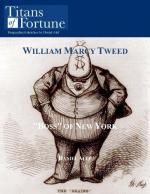
William Marcy Tweed (1823-1878) was an American politician and leader of Tammany Hall. The Tweed ring, which defrauded New York City of millions, made his name a symbol of civic corruption.

William Tweed was born in New York City on April 3, 1823. His father was a chair manufacturer. Tweed left school to learn chair making at the age of 11. At 13 he was apprenticed to a saddlemaker; at 17 he became a bookkeeper in a brush business, at 19 joined the firm, and at 21 married the daughter of the firm's chief owner. But Tweed, "full of animal spirits," as one contemporary described him, found greater excitement in New York's volunteer fire department. In 1850 he became foreman of the celebrated "Americus No. 6" company, which, a year later, helped elect him Democratic alderman.

In Tammany Hall politics there were at least two classic routes to power--hard work combined with loyalty, or aggressiveness and luck. Tweed followed the latter. After serving as an alderman, he was in the U.S. Congress for a term (1853-1855); not only did this experience destroy Tweed's appetite for national politics but it put him out of touch with New York politics. But Tweed soon gained power in party and city affairs. His official positions included membership on the city board of supervisors, state senator, chairman of the state finance committee, school commissioner, deputy street commissioner, and commissioner of public works.

During the 1860s Tweed parlayed political influence into hard cash. Despite meager legal knowledge, he opened a law office to dispense "legal services" to such corporations as the Erie Railroad. He bought a printing company that monopolized city contracts, and a marble company that sold materials for the new courthouse at exorbitant prices. By 1867 Tweed was a millionaire and moved his family to a fashionable neighborhood. The following year he became grand sachem of Tammany.

The Tweed ring began in 1866, tightening operations in 1869, when "Boss" Tweed and others arranged that all bills to the city would henceforth be at least one-half fraudulent, a proportion later raised to 85 percent. The proceeds went equally to Tweed, to the city comptroller, to the county treasurer, and to the mayor. A fifth share was used to bribe officials and businessmen. The boss rallied diverse groups behind his regime by providing "something for all."

Tweed was well suited by temperament and personality for this. Almost 6 feet all, a ruddy 300 pounds, he combined coarse good fellowship with practiced suavity, becoming a favorite of all, including, for a time, some of New York's "best people." Like a good 19th-century entrepreneur, he maximized short-run profits, which were massive. The county courthouse cost $12 million; two thirds was fraudulent. Between 1866 and 1871 (when the ring was exposed) the Tweed ring's services cost the city between $40 and $100 million.

The reform coalition that exposed the ring included city patricians, the New York Times, and assorted political enemies within both parties; motives varied. The battle ended with imprisonment for Tweed and several associates. Initially sentenced to 12 years, Tweed went free in 1875. Rearrested on further charges, he was reimprisoned following a sensational escape to Spain. He died in jail on April 12, 1878. A century later, his grotesquely dishonest career seems a significant chapter in the urban crisis, social and governmental, which Americans have not been able to solve.

This is the complete article, containing 558 words (approx. 2 pages at 300 words per page).

View More Summaries on William M. Tweed
More Information
  • View William Marcy Tweed Study Pack
  • 51 Alternative Definitions
  • Search Results for "William Marcy Tweed"
  • Add This to Your Bibliography
  • More Products on This Subject
    William Marcy Tweed
    William Marcy Tweed, known as Boss Tweed, was the leader of the New York City Democratic Party orga... more

    Boss Tweed
    William Marcy Tweed (3 April 1823 - 12 April 1878), known as Boss Tweed, was an American politician... more


    Ask any question on William M. Tweed and get it answered FAST!
    Answer questions in BookRags Q&A and earn points toward
    discounted or even FREE Study Guides and other BookRags products!
    Learn more about BookRags Q&A
    Copyrights
    William Marcy Tweed from Encyclopedia of World Biography. ©2005-2006 Thomson Gale, a part of the Thomson Corporation. All rights reserved.

    Join BookRagslearn moreJoin BookRags


    About BookRags | Customer Service | Report an Error | Terms of Use | Privacy Policy

