
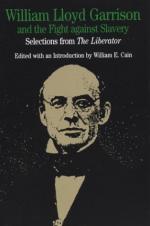
| Name: |
William Lloyd Garrison |
| Birth Date: |
|
| Death Date: |
|
| Place of Birth: |
|
| Nationality: |
|
| Gender: |
|
| Occupations: |
|
The Principal collections of William Lloyd Garrison's papers are at Boston Public Library, Smith College, and Houghton Library, Harvard University.
William Lloyd Garrison (10 December 1805-24 May 1879) is remembered as the foremost journalist of the anti-slavery cause, but he was intimately involved with the whole spectrum of humanitarian reform in the early nineteenth century, including the crusades for peace, for temperance, and for woman's rights, as well as abolition. He was born in Newburyport, Massachusetts, to parents recently arrived from Nova Scotia. After his father deserted the family in 1808, William Lloyd's childhood became a series of difficult adjustments. He served a partial apprenticeship as a shoemaker, ran away from another as cabinetmaker, and finally found his niche as a printer's apprentice in 1818. His youthful associations were solidly Baptist and Federalist; their rigidity imposed itself on Garrison's mind.
During his years as a printer's apprentice, Garrison, like Benjamin Franklin before him, honed his writing skills by composing essays for the paper, first anonymously and later in his own name. After completing his training he edited the Newburyport Free Press for six months, then did job printing for a time before taking over the National Philanthropist at Boston. He expanded the scope of this temperance paper to cover other reforms and imparted to it a militant tone. His crisp style attracted attention and brought him an invitation to edit the Journal of the Times at Bennington, Vermont.
Before leaving Boston, Garrison met the Quaker abolitionist Benjamin Lundy and was converted to the anti-slavery cause. He used the Journal of the Times, which he edited from October 1828 to April 1829, to attack both slavery and Andrew Jackson, and after Jackson's election Garrison moved to Baltimore to join Lundy in editing his peripatetic Genius of Universal Emancipation.
On his way to Baltimore Garrison stopped in Boston to deliver a ringing address in Park Street Church calling on all Christians to mount a crusade against slavery. He had already moved beyond Lundy's views, which favored gradual abolition and colonization of the slaves abroad, to a conviction in favor of immediate emancipation. Garrison was not long with the Genius before he was jailed for libelling a Newburyport slave ship owner. Released after forty-nine days by a contribution from the New York philanthropist Arthur Tappan, Garrison settled in Boston and began the Liberator in January 1831. The peroration of his opening editorial is his most famous utterance: "I am in earnest. I will not equivocate. I will not excuse. I will not retreat a single inch. AND I WILL BE HEARD."
Garrison was as good as his word. For the next thirty-five years, in speeches and in the columns of the Liberator, he poured fiery invective on the heads of slaveholders and all those willing to compromise with slavery. His tirades made such an impression on the South that it came to be believed there that all Northerners, or at least all abolitionists, thought like Garrison. Yet in the North he was mobbed and threatened as well. His zeal led to the founding of the American Anti-Slavery Society in 1833, but also contributed to its breakup in 1840 because Garrison insisted that all reforms were one, that pacifism and woman's rights could not be shuffled aside in favor of the abolition crusade alone. Garrison almost single-handedly destroyed the American Colonization Society by persuading English abolitionists to shun it. But he wielded less and less influence in organized anti-slavery in America as those who had been won to the cause by his eloquence turned to political action, while Garrison, holding to the perfectionist creed, denounced the Constitution in the words of Jeremiah as "a covenant with death and an agreement with hell." From 1843 the Liberator carried on its masthead the motto, "No Union With Slaveholders," and Garrison maintained his secession position until, as he said, "death and hell" themselves seceded, when he took up the cause of the Union and backed Lincoln. With the Emancipation Proclamation and the Thirteenth Amendment he believed his work was ended, and he concluded the Liberator in December 1865. He remained a reformer but his later approach was more mellow than his earlier uncompromising stands, and he ended as a supporter of the "conservative" American Woman Suffrage Association in opposition to its "radical" rival. He died in New York City.
Garrison's later reputation has varied with the climate of opinion on race in America, but his preeminence as the spokesman of radical perfectionism has never been questioned. To the often windy rhetoric of mid-century reform he brought a prose which cut like a flaming sword through pompous periods and pious attitudes. Many disliked what Garrison said, but he said it so well that no one found it possible to ignore him.
This is the complete article, containing 787 words
(approx. 3 pages at 300 words per page).
View More Summaries on William Lloyd Garrison

