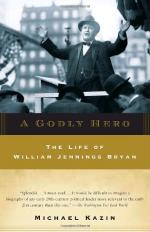
World of Criminal Justice on William Jennings Bryan
William Jennings Bryan spent a lifetime giving speeches and running for office but is best remembered for his involvement in one of the most publicized legal battles of the twentieth century. Bryan was born in Salem, Illinois, on March 19, 1860, and was introduced to the legal world at an early age through his father's career as a politically active circuit judge. After primary school, Bryan attended Illinois College and went on to graduate from Union College of Law (the predecessor to Northwestern Law School) in 1883. Shortly after law school, Bryan married Mary Baird and began a legal practice in Jacksonville, Illinois. His practice proved to be financially unsuccessful and Bryan moved his family west to Lincoln, Nebraska, following rumors of greater career opportunities.
After moving to Nebraska, Bryan became interested in politics and served as a congressman for five years. In 1895, following an unsuccessful bid for Senate, Bryan found himself unemployed and reverted to his talents in oratory. He entered the paid lecture circuit and began to travel all over the country delivering lectures on social, political, and economic issues. Bryan also received the Democratic Party's nomination for president in 1896, 1900, and 1908. He lost all three elections, but Woodrow Wilson later appointed Bryan to his cabinet to serve as Secretary of State. However, Bryan resigned from the position two short years later in 1915 to lead large peace rallies in New York City.
After several years of lecturing, often giving the same memorized speech dozens of times, Bryan was requested to assist in prosecuting a case that would later come to be known as "The Scopes Trial." A high school biology teacher, John Scopes, had agreed to help test a Tennessee law prohibiting the teaching of any theories that contradicted creationism. Scopes was going to be represented by a team led by experienced attorney Clarence Darrow. Despite caveats from friends and family, regarding his poor health and a thirty-year absence from the practice of law, Bryan agreed to help prosecute Scopes. As a lifelong Baptist, Bryan stubbornly argued that he wished to defend his Christian faith one last time.
The trial began on a hot July day in Dayton, Tennessee, where Bryan dismissed Darrow's First Amendment arguments and counter-argued that he was attempting to protect parents' rights to safeguard their children's religious views. In a fatal strategic move for Bryan, he agreed to allow Darrow to question him on the witness stand regarding his religious views. Darrow publicly humiliated Bryan during the questioning, but Bryan remained optimistic that he could regain credibility during his ninety minute prepared closing argument. Bryan's summation was not heard in the courtroom, because in lieu of a closing argument, Darrow pleaded Scopes' guilt. As a result, closing arguments were waived, and the jury returned a guilty verdict in nine minutes. After the trial, Bryan made arrangements to have his undelivered summation speech printed in the newspaper and planned to deliver it to live audiences. However, he died from complications to his diabetes five days after the trial and was buried in Arlington Cemetery.
This is the complete article, containing 510 words
(approx. 2 pages at 300 words per page).