|
This section contains 821 words (approx. 3 pages at 300 words per page) |

World of Sociology on William James
William James was born January 11, 1842, in New York City, and died at his home in Chocorua, New Hampshire, on August 26, 1910. His family's wealth made travel and adventure a major part of his lifestyle while he was growing up. His education, therefore, came from tutors and private schools. He and his father, theologian Henry James, Sr., were very close. His father supported anything that William James wanted to do. However, his formal schooling was irregular and intermittent owing in part to the accidents of residence, and in part to his father's scrupulous regard for the genius of his children and his desire that they should develop from within rather than be molded from without. In consequence, James was impulsive in his studies. He began his higher education studying art under William Morris Hunt making a major change of course to study chemistry in 1861 at Lawrence Scientific School at Harvard. He then changed course again and decided to study medicine in 1864 at Harvard Medical School. He received his Medical Degree in 1869 but did not have much respect for the medical profession at the time of his studies at Harvard.
In the fall of 1872, James was appointed instructor in physiology in Harvard College where he taught courses in the biological sciences, a field closely related to both philosophy and psychology at the time, for the next ten years. He married Alice Howe Gibbens on July 10, 1878. Together they had five children: Henry, William, Herman (who died in one year after birth from pneumonia), Margaret Mary, and Alexander Robert.
William James published his most impressive work The Principles of Psychology in 1890 after 12 years of research. This was his defining work that lives on almost a century after his death due to its in-depth research on the discipline of psychology. Today this work is considered the definitive work of nineteenth-century psychology due to its comprehensive research. James himself realized, though, that the book would be outdated soon after its publication due to the research into a field that was, at the time, becoming newly recognized as a science. One idea put forth in this work, "stream of consciousness," describes the human thought process as flowing like a river of ever-changing thoughts, even while dreaming. This thought process never takes the same path twice.
James' ideas were controversial in both the fields of psychology and philosophy. James believed that the medical profession should not rule out such hard to understand events as supernatural healing and psychic phenomena simply because there is no scientific evidence. He wanted to change the field of philosophy to encompass everyday life and personal experience. He considered philosophy until that point to be nothing more than biographies of past philosophers.
Between 1879 and 1897, James intermittedly published articles that were collected in The Will to Believe. The radical empiricism that had been anticipated in the Principles was formally announced in the preface of this volume. The most significant article, "The Sentiment of Rationality," dealt with "the purely theoretical of logical impulse,"--comprising the "passion for simplification" and the opposing passion for making distinctions. The remaining chapters undertook the psychological project of discussing "practical and emotional motives" and the "soundness of different philosophies." But the titular essay, "The Will to Believe," took the more advanced position that philosophies might legitimately be adopted from such motives.
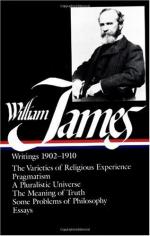
The Varities of Religious Experience, 1902, encompassed another collection of essays. This work approached religion empirically and examined the validity of religious knowledge. James contended that religious beliefs must be fruitful, and mist be in agreement with man's moral and esthetic demands. The religious hypothesis has, in other words, two types of proof, the proof by immediate experience and the proof by life. He sought to define and systematize a metaphysics that would offer a satisfactory conception of reality.
James' major work in philosophy, Pragmatism, was published in 1907. His philosophy was based on individuality. He denied that there could ever be absolute truth. The doctrine that truth of ideas is relative to the interests which generate them implies nothing whatsoever regarding the character of these interests. Hence, James' pragmatism did not emphasize worldly success, but the human interpretation of reality and the role of subjective interests in an individual' interpretation. The most common charge brought against him, however, was that of skeptical subjectivism.
Although suffering from intermittent periods of ill-health, James continued to devote himself to teaching, lecturing, reading, and writing. Other significant works include Some Problems in Philosophy, a compilation of lectures given as a visiting professor at Stanford University, Essays in Radical Empiricism, 1912, a series of articles in which James was prepared to take reality for what it appeared to be, and Talks to Teachers on Psychology: and to Students on Some of Life's Ideals , a collection of lectures that popularized his ideas, emphasizing the unique experience of each individual and providing a foundation for the newer discipline of educational psychology.
|
This section contains 821 words (approx. 3 pages at 300 words per page) |