
 Print
Print Word
Word PDF
PDF|
This section contains 5,671 words (approx. 19 pages at 300 words per page) |

|
Dictionary of Literary Biography on William Gaddis
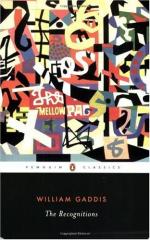
For William Gaddis, writing novels entailed a quasi-religious seriousness, akin, in spirit, to a ceremony of consolation. His novels may appear different from one another on the surfaces; yet, they each return to a set of abiding concerns, including the quest for a sense of purpose, an answer to the central question, "what really is worth doing"" Tony Tanner's evaluation of Gaddis's first novel, The Recognitions (1955), as "ultimately . . . a religious book" is relevant to all of his novels, despite the novelist's attempt "to seek authenticity in negation."
Gaddis was born in New York City on 29 December 1922. His father, William Thomas Gaddis, worked "on Wall Street and in politics," and his mother, Edith Gaddis, was an executive for the New York Steam Corporation. His parents separated when he was three, leaving Gaddis to be raised by his mother in Massapequa, Long Island. As a boy he was sent to...
|
This section contains 5,671 words (approx. 19 pages at 300 words per page) |
|



