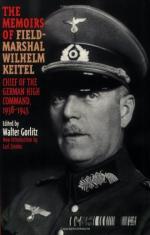
Wilhelm Keitel was a German field marshal and head of the German high command during World War II. Keitel, who excelled at administrative detail, became Adolph Hitler's trusted link to the German military leadership. He was regarded as Hitler's mouthpiece and did not initiate actions on his own. Following the defeat of Germany in 1945, Keitel was indicted and convicted by the International Military Tribunal (IMT) at Nuremberg for war crimes.
Keitel was born on September 22, 1882 in Helmscherode, Germany. Keitel entered the army in 1901 and was commissioned an officer in a field artillery regiment. During World War I he served mainly as a staff officer after being slightly wounded by shrapnel. In 1915 his career prospects improved when he was assigned to the general staff. After Germany's surrender in 1918, Keitel held a series of administrative posts in the reconstituted army. During this period, which lasted until Hitler assumed power in 1933, Keitel spent time in the Soviet Union developing and testing equipment and tactics with the Soviet army.
In 1933 he was promoted to major general, and in 1934 he was given command of an infantry division. It was during this time that Keitel became enamored of Hitler. During the period from 1935 to 1938 Hitler removed a number of generals he considered disloyal and began to reshape the German high command. Keitel, who participated in the design of a unified command structure, attracted Hitler's attention. In 1938 Hitler appointed him to head this new command structure, recognizing that Keitel would follow his orders without question.
After his elevation Keitel worked to ensure that Austria and Czechoslovakia came under Nazi rule quickly and efficiently. He participated in the planning for the 1939 invasion of Poland, the action that precipitated World War II, and dictated the terms of surrender to the French government in 1940. Hitler promoted Keitel to field marshal in 1940, and almost immediately he began working on plans for the invasion of the Soviet Union. The Russian campaign proved disastrous for Germany, and Keitel signed orders that decreed that captured Soviet officials were to be shot and absolved German soldiers for war crimes against the Slavic people.
Keitel remained loyal to Hitler and proved it when he helped stop an attempted coup in July 1944. He was captured by the British in May of 1945 and was indicted by the IMT for war crimes in August of that year. At his trial with other top Nazi officials at Nuremberg, Keitel's war planning activities were produced as evidence of crimes against peace. His orders during the Russian offensive were cited as evidence of war crimes against civilians.
Keitel, unlike most of the defendants, did not evade responsibility for his actions. He testified that he bore the responsibility for all things that resulted from his signed orders. In October 1946 he was found guilty of the charges and sentenced to death. He was hanged on October 16, 1946 in Nuremberg, after the tribunal refused his request to be executed by a military firing squad.
This is the complete article, containing 503 words
(approx. 2 pages at 300 words per page).