|
This section contains 997 words (approx. 4 pages at 300 words per page) |

World of Criminal Justice on Thurgood Marshall
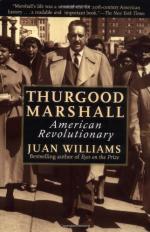
Thurgood Marshall was the first African American member of the U.S. Supreme Court. Before his service on the bench, Marshall was an attorney for the National Association for the Advancement of Colored People (NAACP). He also served as a federal appeals court judge and as solicitor general of the United States.
Marshall was born on July 8, 1908 in Baltimore, Maryland, the son of a railroad porter and a schoolteacher. In 1930, he graduated from Lincoln University, an all-black college in Pennsylvania, and entered Howard University Law School. Marshall had wanted to attend the University of Maryland law school, but state law prohibited the admission of African Americans. He was mentored by the dean of the school, Charles Hamilton Houston, who urged his students to use the legal system to change and improve society. In 1933 Marshall graduated first in his class.
Following graduation, Marshall set up a private practice and represented poor clients in civil rights cases. In 1936 when Houston hired him as a staff attorney for the NAACP. By 1940, Marshall headed the NAACP Legal Defense Fund, a key civil rights organization that he would lead until 1961. As the director of the fund, he coordinated a national campaign against state-sponsored segregation. He and his team of lawyers used the courts to outlaw segregated professional and graduate schools funded by the states.
Their first victory came in 1938, when the Supreme Court, inMissouri ex rel. Gaines v. Canada, 305 U.S. 337, 59 S.Ct. 232, 83 L.Ed. 208 (1938), reviewed a case involving a black applicant who was denied admission to the University of Missouri Law School. The state of Missouri, which had no law schools for blacks, attempted to fulfill its separate-but-equal obligations by offering to pay for the black applicant's tuition at a comparable out-of-state school. The Supreme Court held that this arrangement violated the applicant's rights guaranteed by the Equal Protection Clause. The court ruled that Missouri as required to provide African American law students with equal educational opportunities within its own borders and could not evade this responsibility by relying on educational opportunities offered in neighboring states.
This litigation led to the momentous decision by the Supreme Court inBrown v. Board of Education, 347 U.S. 484, 74 S.Ct. 686, 98 L.Ed.2d 873 (1954). In his argument to the Court, Marshall contended that the laws in question were equivalent to the laws used against slaves. He also claimed that a reaffirmation of the "separate but equal" doctrine would mean that African Americans would be kept in a state very close to what they endured during slavery.
The court overturned the separate but equal doctrine it had established 50 years before and announced that the 21 states that mandated racially segregated schools must end the practice. The court held that separate-but-equal education is "inherently unequal" and "has no place" in the field of public education. Citing previous decisions won by Marshall, Chief Justice Earl Warren reiterated that a student's ability to learn is stunted without exposure to the viewpoints of different races. He underscored the sociological and psychological harm segregation inflicts on minority children, finding that segregation "is usually interpreted as denoting the inferiority of the Negro group." Marshall and his team of lawyers had prevailed, but it had taken over 20 years to build the legal case for desegregation.
President John F. Kennedy appointed Marshall to the U.S. Circuit Court of Appeals for the Second Circuit in 1961. Despite bitter opposition from southern senators who were opposed to desegregation, the Senate confirmed Marshall. In 1965, President Lyndon B. Johnson asked Marshall to give up his lifetime judicial appointment and become solicitor general of the United States. In this position, Marshall argued cases for the federal government before the Supreme Court.
In 1967, Johnson appointed Marshall to the Supreme Court. The first African American to serve on the High Court, Marshall exhibited the same values he displayed as a civil rights attorney. That is, he often dissented from the majority, issuing caustic opinions that disparaged capital punishment, civil rights abuses, and unequal treatment of racial minorities. Marshall was adamantly opposed to capital punishment, believing its application violated the Eighth Amendment prohibition against cruel and unusual punishment. When the Supreme Court upheld the constitutionality of newly-revised death penalty statutes inGregg v. Georgia, 428 U.S.153, 96 S.Ct. 2909, 49 L.Ed.2d 859 (1976), he established the practice of filing a dissenting opinion in every death penalty case.
Marshall was also an early opponent of racial profiling, where police target individuals for investigation based on their race. In< United States v. Soklolow /emphasis>, 490 U.S. 1, 109 S.Ct. 1581, 104 L.Ed.2d 1 (1989), the Supreme Court upheld the use of profiles that law enforcement officials used at airports to investigate possible drug couriers. Marshall wrote a vigorous dissent, arguing that the supposedly objective criteria were contradictory and weighted toward the identification of racial minorities. Marshall was a firm believer in First Amendment rights and wrote the majority opinion that gave individuals the right to possess obscene materials in their own home. He also wrote the decision that established the principle that the government may not constitutionally favor some types of speech over others.
Throughout his judicial career, Marshall expressed his outrage at unequal application of laws. InSan Antonio Independent School District v. Rodriguez, 411 U.S. 1, 93 S.Ct. 1278, 36 L.Ed.2d 16 (1973), the court upheld a Texas property tax system used to fund public education. The court found it acceptable although it allowed wealthier districts to provide better school systems than less wealthy districts could provide. Marshall criticized the property tax arrangement, contending that it deprived poor children equal protection of the law.
Marshall was a strong advocate of affirmative action programs. His convictions helped move the court inRegents of the University of California v. Baake, 438 U.S. 265, 98 S.Ct. 2733, 57 L.Ed.2d 750 (1978) to uphold the constitutionality of programs that consider race in employment hiring practices and educational admission decisions. Marshall retired in 1991. He died on January 25, 1993 in Bethesda, Maryland.
|
This section contains 997 words (approx. 4 pages at 300 words per page) |