
BookRags.com Literature Guides Literature
Guides
Criticism & Essays Criticism &
Essays
Questions & Answers Questions &
Answers
Lesson Plans Lesson
Plans
My Bibliography Periodic Table U.S. Presidents Shakespeare Sonnet Shake-Up
Research Anything:        
History | Encyclopedias | Films | News | Create a Bibliography | More... Login | Register | Help

Not What You Meant?  There are 24 definitions for Wilder.

Thornton (Niven) Wilder Biography

Print-Friendly  Order the PDF version  Order the RTF version
About 2 pages (541 words)
Thornton Wilder Summary

Bookmark and Share Questions on this topic? Just ask!
Name: Thornton Niven Wilder
Birth Date: April 17, 1897
Death Date: December 7, 1975
Place of Birth: Madison, Wisconsin, United States
Place of Death: Hamden, Connecticut, United States
Nationality: American
Gender: Male
Occupations: playwright, novelist

Dictionary of Literary Biography on Thornton (Niven) Wilder

Thornton Wilder, the only writer to receive Pulitzer Prizes for both plays and a novel, once observed, "I guess I was the only writer of my generation who didn't 'go to Paris!'" For him the road abroad led to Rome, which he first visited in the summer of 1920, after graduating from Yale, as a resident visitor at the American Academy. The influence of Greco-Roman culture and his Italian friendships is apparent in his novels The Cabala (1926), The Woman of Andros (1930), and The Ides of March (1948).

Wilder did visit Paris several times during the twenties, however, beginning in the spring of 1921 when he wished to brush up on his French before returning to teach at Lawrenceville Academy. On another trip in 1926, Sylvia Beach introduced him to Ernest Hemingway, with whom he became friendly. But none of these brief visits affected his work. He did not become a part of the American literary enclave in Paris until after one of Gertrude Stein's infrequent visits to her native country after she had settled in France in 1903. In November 1934, she came to lecture at the University of Chicago, where Wilder was teaching, and though he had not been impressed with her writings previously, they became good friends. He agreed to write a foreword to Narration (1935), based on her lectures in Chicago; and on 6 July 1935, he arrived in Paris to visit with Stein and Alice B. Toklas there and at their country house in Bilignin, where Stein unfolded plans for future collaborations. Although Wilder refused to become involved in all her schemes, he was profoundly influenced by his association with her. As Richard Goldstone explains in his biography of Wilder, "He left Bilignin, more determined than ever that he would write plays"--plays influenced by Stein's pioneering efforts to renounce traditional plot and dramatic action and "to express human emotions as they are, rather than in the heightened and strained state produced by the conventional dramatic situations."

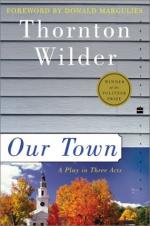
The immediate fruit of Wilder's Parisian experience was Our Town (1938), in which he returned to a technique that he had employed in some earlier one-act plays. Set on a bare stage with a minimum of props, Our Town is a universal tale of love and death presented in the microcosm of a New Hampshire village. Many European influences combined to shape The Merchant of Yonkers (1939), a comedy based on a nineteenth-century British version of an Austrian farce. The play was not successful at first, but revised as The Matchmaker in 1955, it served as the basis for the enormously successful musical comedy, Hello, Dolly. The Parisian influences of Gertrude Stein and Irish expatriate James Joyce are strongest in The Skin of Our Teeth (1942), where Wilder presents through the Antrobus family the archetypal history of the triumph of the human spirit over catastrophes like glaciers, floods, and wars.

Wilder returned to Paris briefly in 1937 and again in 1939 to plead with Gertrude Stein to return to the United States before the German invasion. Although he spent little time in France, the plays influenced by his Parisian experience epitomize the freedom, individuality, experimentation, and faith in man's indomitable spirit that was shared by many of the American writers in France.

This is the complete article, containing 541 words (approx. 2 pages at 300 words per page).

View More Summaries on Thornton Wilder
More Information
  • View Thornton (Niven) Wilder Study Pack
  • 24 Alternative Definitions
  • Search Results for "Thornton (Niven) Wilder"
  • Add This to Your Bibliography
  • More Products on This Subject
    Thornton Niven Wilder
    On the strength of only three full-length plays and a bare handful of one-acts, Thornton Wilder ran... more

    Thornton Niven Wilder
    Novelist and playwright Thornton Niven Wilder (1897-1975) won two Pulitzer Prizes for his plays Our... more


    Ask any question on Thornton Wilder and get it answered FAST!
    Answer questions in BookRags Q&A and earn points toward
    discounted or even FREE Study Guides and other BookRags products!
    Learn more about BookRags Q&A
    Copyrights
    Warren French, Indiana/Purdue Universities, Indianapolis. Thornton (Niven) Wilder from Dictionary of Literary Biography. ©2005-2006 Thomson Gale, a part of the Thomson Corporation. All rights reserved.


    Join BookRagslearn moreJoin BookRags


    About BookRags | Customer Service | Report an Error | Terms of Use | Privacy Policy

