BookRags.com Literature Guides Literature Guides Criticism/Essays Criticism/Essays Biographies Biographies My Bibliography Periodic Table U.S. Presidents Shakespeare Sonnet Shake-Up
Research Anything:        
History | Encyclopedias | Films | News | Create a Bibliography | More... Login | Register | Help

Search "Thomas Robert Malthus"

Biographies Navigation
 

Thomas Robert Malthus Biography

Print-Friendly  Order the PDF version  Order the RTF version
About 2 pages (670 words)
Thomas Malthus Summary

Bookmark and Share
Name: Thomas Robert Malthus
Birth Date: 1766
Death Date: December 23, 1834
Place of Death: Haileybury
Nationality: English
Gender: Male
Occupations: economist

World of Biology on Thomas Robert Malthus

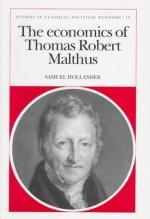
Thomas Robert Malthus was born in 1766 southwest of London in Surrey. Malthus had an enormous impact on scholars of biology, human populations and economics. He entered Jesus College at Cambridge in 1784 and graduated four years later at which time he was ordained in the Church of England. He served for a brief time as a curate in a parish not far from where he was born. He later became a Fellow of Jesus College and also a Fellow of the Royal Society. In 1805 he became a professor of history and political economy at the East India Company's college at Haileybury in Hertfordshire.

He is remembered not because of the holy orders that he took. Rather, his essays on population brought recognition to him worldwide. He was not optimistic with regard to the lot of working humans at the time. He believed that the means of subsistence would always be in short supply because of human reproduction. He thought that human reproduction would always outstrip the capacity of the land to produce food. Ultimately, it was the availability of food that would set population limits. Famine, disease, and infant mortality would take their toll because of inadequate food supplies. The views of Malthus were articulated at a time when it was hoped that the poor laws would encourage population growth and the increased population would insure national wealth. The dire views of Malthus were exactly opposite those of most other scholars at the time. He urged that a nation balance production with consumption. He suggested that public works would provide relief for the working poor. He published some of his ideas in his Essay on the Principle of Population in 1798. The essay was revised and enlarged for a total of six editions all of which carried his name except the first which was anonymous.

Charles Darwin (1809-1882) acknowledged that he read Malthus. Darwin recognized that uncontrolled reproduction coupled with limited means of subsistence would create a struggle for existance with survival of only those best suited. Animals, as humans, vary in capabilities related to survival. The struggle, according to Darwin, selected those best fit for survival. Darwin had just returned from the voyage of the Beagle and he recognized that the Malthusian population concept applies to animals as well as humans. Thus, Malthus indirectly contributed to Darwin's theory of natural selection. Alfred Russell Wallace (1823-1913), whose views on natural selection were similar to Darwin, also acknowledged reading Malthus.

Malthus, who believed that public works were a means of minimizing economic distress of the poor, was said to have influenced the English economist John Maynard Keynes (1883-1946) who advocated governmental aid for full employment as a means of digging out of economic depression. And, certainly the administration of Franklin Delano Roosevelt (1882-1945) did in fact institute vast public projects to rescue the poor and to stimulate production.

Public concern for overpopulation and inadequate food supply is greater now than it was in the time of Malthus. Malthus did not provide easy answers for this problem. He was against contraception and against abortion. In lieu of disease and famine, he offered delayed marriage. The issues are more complicated now. The American Nobel Laureate Norman E. Borlaug (1914-), the father of the green revolution, has averted famine for much of the world, at least for the time being, by vastly increasing the food supply with modern agriculture. Here is an instance where the means of subsistence has increased at an incredible pace not foreseen by Malthus. Curiously, modern refrigerators have decreased food spoilage and waste. Hence, there has been a period when food supplies have been relatively abundant. Birth control by means of the pill, or with the condom, offer options not previously available for population control. Welfare laws are being changed in an effort to not encourage large families. Thomas Robert Malthus would be excited indeed to learn how human society will handle the problem of limited means of subsistence and the pressing burden of population growth over two centuries after his death.

This is the complete article, containing 670 words (approx. 2 pages at 300 words per page).

View More Summaries on Thomas Malthus
More Information
  • View Thomas Robert Malthus Study Pack
  • Search Results for "Thomas Robert Malthus"
  • Add This to Your Bibliography
  • Take the Free IQ Test on BookRags!
  • More Products on This Subject
    Thomas Robert Malthus
    The English economist Thomas Robert Malthus (1766-1834) was of the classical school and was the fir... more

    Thomas Robert Malthus
    Thomas Robert Malthus was born at his family's country home in Wotton, Surrey, on February 13, 1766... more


    Copyrights
    Thomas Robert Malthus from World of Biology. ©2005-2006 Thomson Gale, a part of the Thomson Corporation. All rights reserved.

    Join BookRagslearn moreJoin BookRags


    About BookRags | Customer Service | Report an Error | Terms of Use | Privacy Policy