
Forgot your password?  

Thomas Browne, Sir Biography

This Biography consists of approximately 2 pages of information about the life of Thomas Browne.
PDFPDF
Download:
Bookmark and Share
This section contains 564 words
(approx. 2 pages at 300 words per page)

Encyclopedia of World Biography on Thomas Browne, Sir

The works of the English author Sir Thomas Browne (1605-1682) are in large part inquiries into religion, morality, science, and human error. A doctor and scholar, he is chiefly famed for Religio medici, which is marked by his masterly prose style.

Thomas Browne was born in Cheapside, London, on Oct. 19, 1605. He was the son of a mercer of genteel Cheshire ancestry who died 8 years later, leaving "a plentifull Fortune." After earning a master's degree at Oxford in 1629, Browne studied medicine in Montpellier, Padua, and Leiden, where he received a degree in medicine in 1633. About 1635, while a young doctor in Yorkshire, he composed Religio medici (A Doctor's Religion) "as a personal exercise." In 1637 he settled in Norwich and gained esteem as a doctor who kept abreast of current revolutionary developments in medicine, such as William Harvey's discovery of blood circulation. In 1641 Browne married Dorothy Mileham, who bore him 12 children in 18 years, though he had professed in the Religio that he "could be content" if men procreated "like trees without conjunction."

Although Norwich was a Parliamentary stronghold, Browne remained a staunch royalist throughout the Puritan Revolution (1642-1660). His Religio, published without his permission in 1642 but in an authorized edition the next year, contrasts with the doctrinaire religious rigidity of his contemporaries. He writes as a humane Anglican, convinced of his own faith, enraptured by the wonders of theology, but open-minded and aware of the limitations of human reason and the folly of pious prejudices. In an age of intolerance he respected every man's right to decide on his own beliefs: "I could never divide myself from any man upon the difference of an opinion."

The Religio is a deliberately digressive, eclectic, charmingly erudite testimonial of Browne's experiences in religion and thought. He explores such topics as the relations of reason and faith, nature as God's art, musical harmonies, witchcraft, and man as inhabiting the "divided and distinguished worlds" of soul and spirit, reason and sense. The treatise is a revelation of self, reminiscent of Montaigne, but it is written from the perspective of eternity and couched in richly cadenced, imaginative, ornate, and flexible prose.

Pseudodoxia epidemica, or Vulgar Errors (1646) now seems more quaint than scientific, but it was practical in an age bound by traditional fallacies. Its purpose was to induce inquiries into popular delusions; for example, Browne denies that elephants lack knees, that crystal is hard ice, and that rubbing with garlic inhibits a magnet's power to attract.

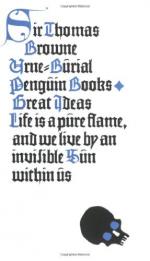
In 1658 Browne published Hydriotaphia, or Urn Burial and its companion, The Garden of Cyrus. The first reflects on ancient burial customs, life's mystery, and the futility of pagan piety. The second discovers quincunxes (patterns of fives) throughout nature and man's works and thus probes into the mysteriously intricate unity of things.

After the Restoration, Browne was elected a fellow of the Royal Society of Physicians, and in 1671 Charles II knighted him. Browne died on his birthday in 1682. His Letter to a Friend and Christian Morals found posthumous publication. Since then his works have been persistently reprinted, and he has won ever-increasing respect as a man of virtuous life dedicated to the progress of medicine and scientific experimentation and to appreciation of the mysteries of God, man, and nature. Above all, he is esteemed for a style rich in tone, exquisite in prose poetry, and superbly flexible in rhetoric.

This section contains 564 words
(approx. 2 pages at 300 words per page)
Copyrights
Thomas Browne, Sir from Encyclopedia of World Biography. ©2005-2006 Thomson Gale, a part of the Thomson Corporation. All rights reserved.
Follow Us on Facebook
Homework Help

