BookRags.com Literature Guides Literature
Guides
Criticism & Essays Criticism &
Essays
Questions & Answers Questions &
Answers
Lesson Plans Lesson
Plans
My Bibliography Periodic Table U.S. Presidents Shakespeare Sonnet Shake-Up
Research Anything:        
History | Encyclopedias | Films | News | Create a Bibliography | More... Login | Register | Help

Not What You Meant?  There are 36 definitions for Saint Thomas.  Also try: Aquinas.

Thomas Aquinas, St. Biography

Print-Friendly  Order the PDF version  Order the RTF version
About 2 pages (534 words)
Thomas Aquinas Summary

Bookmark and Share Know this topic well? Help others and get FREE products!
Name: Thomas Aquinas, St.
Birth Date: c. 1224
Death Date: March 7, 1274
Place of Birth: Roccasecca, Italy
Place of Death: Fossanova, Italy
Nationality: Italian
Gender: Male
Occupations: philosopher, theologian

World of Physics on Thomas Aquinas, St.

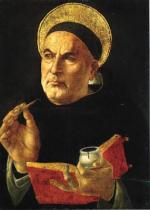
St. Thomas Aquinas was born Thomas d'Aquino near Naples in 1225 to a noble family. His parents, Lundulph, Count of Aquino, and Theodora, Countess of Teano, were related to the Emperors Henry VI and Frederick II, and to the Kings of Aragon, Castile, and France. Known as perhaps the supreme theologian of Catholicism, Aquinas was enrolled in the Benedictine monastery of Monte Cassino at the age of five, where he was noted early for his diligent study and philosophical leanings. Despite his calling to a religious life, Aquinas's mother and family had him kidnapped in May of 1244 after he had become a Dominican friar the month before. They kept him for more than year to persuade him to give up his membership in the Dominican order. Aquinas would not renounce his calling, and they allowed him to return to his order in 1245. He went on to attend the University of Naples and studied under the German philosopher Albertus Magnus (c.1200-1280), author of writings on the Aristotelian corpus, from 1245-1252. Ordained a priest in 1250, Aquinas began teaching at the University of Paris in 1252. Humble, taciturn, and heavy set, he was referred to as the "Dumb Ox." However, Magnus recognized Aquinas's keen intellect and proclaimed that "this ox will one day fill the world with his bellowing."

Although known primary as a theologian and philosopher, Aquinas was also a man of science and sought to bring philosophy and science together in a common field of understanding. Under the tutelage of his mentor, Magnus, Aquinas became a defender of Aristotle's approach to philosophical and scientific inquiry. He classified physics and mathematics as theoretical sciences that seek to understand the world. In his commentary on Aristotle's Sense and Sensibilia, Aquinas states that physics is the first step in the study of the natural world.

Although Aquinas was not an experimental scientist, he tackled, on a philosophical basis, concepts of matter and form. Despite his strong religious faith, Aquinas also believed in the importance of scientific discovery and that the study of the humblest acts is related to the highest truths.

Aquinas's best-known work is Summa Theologiae, which he began in 1266. In it he discuses the existence of God, a system of ethics, and Jesus Christ. In addition to teaching in Paris, Aquinas also taught in Naples and Rome. In 1272, the Catholic Church assigned him to Naples as a regent in theology. On December 6, 1273, Aquinas professed to having a heavenly revelation while celebrating mass in the chapel of St. Nicholas in Naples. Aquinas is reported to have said, "I can do no more... such secrets have been revealed to me that all I have written now appears to be of little value." While attending the Council of Lyon, Aquinas fell and injured himself. His health rapidly deteriorated, and he died on March 7, 1274, at the age of 49. A shrine was erected in 1628, where Aquinas's body remained until the shrine was destroyed during the French Revolution. He was then moved to the Church of St. Sernin, where the body is held in a sarcophagus of gold and silver. He remains the patron saint of all Catholic universities, academies, colleges, and schools.

This is the complete article, containing 534 words (approx. 2 pages at 300 words per page).

View More Summaries on Thomas Aquinas
More Information
  • View Thomas Aquinas, St. Study Pack
  • 36 Alternative Definitions
  • Search Results for "Thomas Aquinas, St."
  • Add This to Your Bibliography
  • More Products on This Subject
    Thomas Aquinas, St.
    The Italian philosopher and theologian St. Thomas Aquinas (ca. 1224-1274) was one of the foremost m... more

    St. Thomas Aquinas
    St. Thomas Aquinas was an Italian theologian and philosopher of the Dominican Order of the Catholic... more


    Ask any question on Thomas Aquinas and get it answered FAST!
    Answer questions in BookRags Q&A and earn points toward
    discounted or even FREE Study Guides and other BookRags products!
    Learn more about BookRags Q&A
    Copyrights
    Thomas Aquinas, St. from World of Physics. ©2005-2006 Thomson Gale, a part of the Thomson Corporation. All rights reserved.


    Join BookRagslearn moreJoin BookRags


    About BookRags | Customer Service | Report an Error | Terms of Use | Privacy Policy