
BookRags.com Literature Guides Literature
Guides
Criticism & Essays Criticism &
Essays
Questions & Answers Questions &
Answers
Lesson Plans Lesson
Plans
My Bibliography Periodic Table U.S. Presidents Shakespeare Sonnet Shake-Up
Research Anything:        
History | Encyclopedias | Films | News | Create a Bibliography | More... Login | Register | Help

Search "Steven (Lewis) Millhauser"

Biographies Navigation
 

Steven (Lewis) Millhauser Biography

Print-Friendly  Order the PDF version  Order the RTF version
About 3 pages (1,034 words)
Steven Millhauser Summary

Bookmark and Share
Name: Steven (Lewis) Millhauser
Variant Name: Steven (Lewis) Millhauser|Steven Lewis Millhause
Birth Date: August 3, 1943
Place of Birth: New York
Nationality: American
Gender: Male

Dictionary of Literary Biography on Steven (Lewis) Millhauser

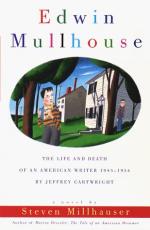
Steven Millhauser, one of the most original novelists to emerge in the 1970s, was born on 3 August 1943 in New York and grew up in Connecticut where his father, Milton Millhauser, was an English professor at the University of Bridgeport. Millhauser received a B.A. from Columbia University in 1965 and later did graduate work at Brown University for three years. The first of his two novels, Edwin Mullhouse: The Life and Death of an American Writer, 1943-1954, by Jeffrey Cartwright (1972), was cited as one of the year's most notable books by Newsweek and Time and won France's Prix Medicis Etranger. The two main concerns of Millhauser's fiction are literature and childhood. His novels contain parodies of specific writers and genres and are heavily allusive. But more important is Millhauser's unsentimental presentation of the pains and pleasures of childhood, a period he rescues from the cliches of popular culture and the stereotypes of the sociologists and psychologists.

Edwin Mullhouse is a twelve-year-old's account of the life of his best friend who has died shortly after completing his one masterpiece, Cartoons, an autobiographical novel which imitates the style of animated films. Edwin Mullhouse is itself three novels in one: a satire of literary biographies, a detective story--since we only learn the shocking cause of Edwin's death in the final pages--and a portrait of a middle-class American childhood in mid-twentieth century. These first two qualities clearly indicate that the novel was inspired by Vladimir Nabokov's Pale Fire, and one reviewer has called Edwin Mullhouse "probably the best Nabokovian novel not written by the master himself."

Biographies from Boswell's Life of Johnson to Leon Edel's five-volume study of Henry James are satirized in Edwin Mullhouse. Jeffrey Cartwright divides the life of his friend into the Early, Middle, and Late Years and is deadly serious about his task: "it is the purpose of this history to trace not the mere outlines of a life but the inner plan, not the external markings but the secret soul." Much of the novel's humor comes from the pomposity of its precocious narrator. Inevitably, Jeffrey confesses the superiority of the watcher to the watched: "I take this opportunity to ask Edwin, wherever he is: isn't it true that the biographer performs a function nearly as great as, or precisely as great as, or actually greater by far than the function performed by the artist himself? For the artist creates the work of art, but the biographer, so to speak, creates the artist. Which is to say: without me, would you exist at all, Edwin""

One of the pleasures of the novel is the way in which Jeffrey reveals his jealous resentment of his subject, as when he tells us that Edwin is "the brightest boy in the class (reputedly)." Similar clues are dropped about the cause of Edwin's death; in Jeffrey's "Preface to the First Edition," he thanks himself "for doing all the dirty work," and he later remarks that "a modest biographer may be driven to strange devices for the sake of his throbbing book." The most cunning clue of all is provided by Edwin himself when he has his hero, at the end of Cartoons, murdered by a mysterious figure in black about whose identity he teases Jeffrey.

But Edwin Mullhouse is more than satire and games-playing. Its primary subject is childhood, which it depicts with no condescension and a minimum of nostalgia. Millhauser's vision of childhood is hardly an idealized one, filled as it is with frustration, disease, and death; its inhabitants are not underdeveloped adults but real people confronting real problems. Yet a freshness, a playfulness, accompanies this seriousness. Boy-artist Edwin is not an aberration; as Jeffrey tells us, "The important thing to remember is that everyone resembles Edwin; his gift was simply the stubbornness of his fancy, his unwillingness to give anything up." Edwin and Jeffrey's world emphasizes the unspoiled pleasures of the everyday and the intense pain unique to this time of life. Millhauser shows how childhood--in fact, all life--cannot be reduced to stereotypes.

Portrait of a Romantic (1977) carries Millhauser's concern with childhood into adolescence as twenty-nine-year-old narrator Arthur Grumm describes his agonies from ages twelve to fifteen. The novel has similarities to Edwin Mullhouse but has a completely different style, tone, and comic design. If Jeffrey Cartwright is a coolly detached observer, for the most part, Arthur Grumm is the impassioned opposite, berating the "smug," "stupid" reader, babbling almost incoherently, whimpering all the way to the novel's end. Arthur says that his problem is his increasing restlessness with the boredom of growing up: "I would be assailed by illicit longings...oh, not those longings, but illicit longings, longings for dangerous and unknown realms of freedom at the opposite end of so-called life." Hiding from the demons of ennui, Arthur drapes the cloak of romanticism over his anguish: "I felt myself becoming a connoisseur of decay, and I dreamed of starting an autumn garden, composed of rows of ruined summer flowers."

The novel concentrates on Arthur's relationships with three fellow sufferers. William Mainwaring, "my double," is another version of Jeffrey Cartwright: a realist who collects stamps and rocks. Philip Schoolcraft, "my triple," represents the other extreme; a worshiper of Poe, more than half in love with easeful death, he leads Arthur into daily games of Russian roulette. Eleanor Schumann, "The Phantom Eleanor," is a pale beauty wilting in her dark, dusty bedroom while constructing elaborate fantasies. Arthur retreats from the latter two disastrous friendships to dependable William, once called "William Wilson" by Philip. (Poe is the restless spirit who haunts Portrait of a Romantic; it is full of "Poetic" allusions, parodies, and puns.) William finally jolts Arthur from his malaise by joining him in a suicide pact, just as Philip and Eleanor have done, though this one is more "successful" than the others.

Portrait of a Romantic is almost as impressive as Edwin Mullhouse, though it occasionally suffers from overwriting. The intense attention to detail of the first novel seems mere verbosity here. The somber comedy is often too dark, obscuring the ironies. Millhauser's triumph in these novels lies in his handling of the disparate sensibilities of his narrators and his uncovering of the violence lurking below the peaceful surface of childhood.

This is the complete article, containing 1,034 words (approx. 3 pages at 300 words per page).

View More Summaries on Steven Millhauser
More Information
  • View Steven (Lewis) Millhauser Study Pack
  • Search Results for "Steven (Lewis) Millhauser"
  • Add This to Your Bibliography
  • More Products on This Subject
    Critical Essay by The New Republic
    Edwin Mullhouse was a Connecticut boy who wrote the novel Cartoons and who died under strange circum... more

    Critical Essay by William Kennedy
    William Faulkner argued that the problems of children were not worth writing about. He wrote frequen... more


    Copyrights
    Michael Adams, University of South Carolina. Steven (Lewis) Millhauser from Dictionary of Literary Biography. ©2005-2006 Thomson Gale, a part of the Thomson Corporation. All rights reserved.


    Join BookRagslearn moreJoin BookRags


    About BookRags | Customer Service | Report an Error | Terms of Use | Privacy Policy

