
BookRags.com Literature Guides Literature
Guides
Criticism & Essays Criticism &
Essays
Questions & Answers Questions &
Answers
Lesson Plans Lesson
Plans
My Bibliography Periodic Table U.S. Presidents Shakespeare Sonnet Shake-Up
Research Anything:        
History | Encyclopedias | Films | News | Create a Bibliography | More... Login | Register | Help

Search "Spartacus"

Biographies Navigation
 
Not What You Meant?  There are 40 definitions for Sparta.

Spartacus Biography

Print-Friendly  Order the PDF version  Order the RTF version
Howard Fast
About 2 pages (566 words)
Spartacus Summary

Bookmark and Share Know this topic well? Help others and get FREE products!
Name: Spartacus
Death Date: 71 B.C.
Gender: Male
Occupations: gladiator

Encyclopedia of World Biography on Spartacus

Spartacus (died 71 BC) was a Thracian gladiator who led a slave war in Italy against the Romans. He plundered most of Italy before being defeated and killed in a pitched battle.

It is not known how Spartacus became a gladiator. He is said to have fought either with or against the Romans. Eventually he found himself in the gladiator school of Gnaeus Lentulus Batiatus at Capua. From there in 73 B.C. some 70 gladiators escaped and fled to Mt. Vesuvius, where they were joined by slaves and farm workers from the countryside. Spartacus with the help of two Celts, Crixus and Oenomaos, led them, forging the motley group into a first-class fighting force.

Roman response to the uprising was at first slow and inadequate. Spartacus defeated local levies led by a propraetor and a praetor in three sharp engagements. The slaves then broke out of Campania and raided all of southern Italy, eventually establishing winter quarters at Thurii and Metapontum in Lucania. There their forces grew to 70,000 men.

In 72 the Senate assigned both consuls and four legions to the war against the slaves. After a minor engagement at Mt. Garganos in which Crixus was killed, Spartacus defeated the two consuls in separate battles in central Italy. At this point he attempted to lead the slaves north to freedom beyond the Alps. But after they defeated the governor of Cisalpine Gaul at Mutina (Modena), they elected to turn back to Italy to plunder and enrich themselves. Spartacus not only threatened Rome itself but again defeated both consuls in a major battle in Picenum. The Romans no longer dared face him in the field. He then returned to southern Italy and again made Thurii his headquarters.

In the autumn of 72 the Senate transferred the command against the slaves to Marcus Licinius Crassus, who held no public office at the time. He recruited six additional legions and took up a protective position in south-central Italy. After an initial defeat Crassus won a victory over a contingent of the slaves. That winter he built a wall and ditch across the toe of Italy to contain Spartacus, whose attempts to escape to Sicily with his army failed.

Early in the spring of 71 Spartacus broke through Crassus' lines but suffered two defeats at his hands in Lucania. He then retired again to Bruttium (Calabria), where he defeated two of Crassus' lieutenants who were following him. Encouraged, Spartacus's men persuaded him to risk a major battle with Crassus. In it Spartacus and 60,000 of his men fell. Spartacus's body was never found. Stragglers from the massacre were caught in Etruria by Pompey, summoned by the people from Spain to help end the war. In a final act of cruelty Crassus crucified 6,000 prisoners along the Via Appia from Capua to Rome.

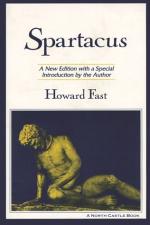
Although Spartacus has been justly lauded as a bold leader, the slave war was not a revolt of the lower classes against the bourgeois leadership of Rome. Spartacus got almost no support from the Italian population, which remained loyal to Rome. Nonetheless, Spartacus has been idolized by revolutionaries since the 18th century. From 1916 to 1919 the German Socialists styled themselves "Spartacists" when they tried to foment a proletarian revolution after World War I. Spartacus's stout resistance against the Romans has been a popular theme among poets and novelists, for example, Arthur Koestler in The Gladiators (1939) and Howard Fast in Spartacus (1951).

This is the complete article, containing 566 words (approx. 2 pages at 300 words per page).

View More Summaries on Spartacus
More Information
  • View Spartacus Study Pack
  • 40 Alternative Definitions
  • Search Results for "Spartacus"
  • Add This to Your Bibliography
  • More Products on This Subject
    Spartacus
    (died 71 &BC;) leader in the Gladiatorial War (73–71) against Rome. A Thracian by birth, Spar... more

    Spartacus
    (died 71 &BC;) Leader in the Gladiatorial War against Rome (73–71). A Thracian, he served in ... more


    Ask any question on Spartacus and get it answered FAST!
    Answer questions in BookRags Q&A and earn points toward
    discounted or even FREE Study Guides and other BookRags products!
    Learn more about BookRags Q&A
    Copyrights
    Spartacus from Encyclopedia of World Biography. ©2005-2006 Thomson Gale, a part of the Thomson Corporation. All rights reserved.


    Join BookRagslearn moreJoin BookRags


    About BookRags | Customer Service | Report an Error | Terms of Use | Privacy Policy

