
 Print
Print Word
Word PDF
PDF|
This section contains 1,559 words (approx. 6 pages at 300 words per page) |

|
Encyclopedia of World Biography on Socrates
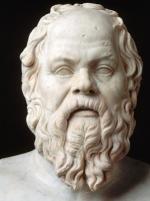
The Greek philosopher and logician Socrates (469-399 BC) was an important formative influence on Plato and had a profound effect on ancient philosophy.
Socrates was the son of Sophroniscus, an Athenian stone mason and sculptor. He learned his father's craft and apparently practiced it for many years before devoting his time almost completely to intellectual interests. Details of his early life are scanty, although he appears to have had no more than an ordinary Greek education. He did, however, take a keen interest in the works of the natural philosophers, and Plato (Parmenides, 127C) records the fact that Socrates met Zeno of Elea and Parmenides on their trip to Athens, which probably took place about 450 BC Socrates wrote nothing; therefore evidence for his life and activities must come from the writings of Plato and Xenophon. It is likely that neither of these presents a completely accurate picture of...
|
This section contains 1,559 words (approx. 6 pages at 300 words per page) |
|



