
BookRags.com Literature Guides Literature Guides Criticism/Essays Criticism/Essays Biographies Biographies My Bibliography Periodic Table U.S. Presidents Shakespeare Sonnet Shake-Up
Research Anything:        
History | Encyclopedias | Films | News | Create a Bibliography | More... Login | Register | Help

Search "Sidney Hook"

Biographies Navigation


Sidney Hook Biography

Print-Friendly  Order the PDF version  Order the RTF version
About 3 pages (906 words)
Sidney Hook Summary

Bookmark and Share
Name: Sidney Hook
Birth Date: December 20, 1902
Death Date: July 12, 1989
Place of Birth: New York, New York, United States
Place of Death: Stanford, California, United States
Nationality: American
Gender: Male
Occupations: philosopher

Encyclopedia of World Biography on Sidney Hook

The philosopher Sidney Hook (1902-1989) was an exponent of classical American pragmatism. He brought the method of intelligence to bear on social issues, education, ethics, and philosophy itself.

Sidney Hook was born on December 20, 1902, to Issac and Jennie Hook. He studied at the City College of New York (BA) and at Columbia University (MA, Ph.D.). While at Columbia Hook studied with John Dewey. Without doubt Hook was the most distinguished of Dewey's students and one of the best exponents of classical American pragmatism. He lectured at universities throughout the United States and after 1927 taught in various capacities at New York University. Hook served as the head of the Department of Philosophy of New York University from 1948 to 1969, during which time he founded the New York University Institute of Philosophy.

Widely recognized for his contributions to philosophy, Hook received numerous honorary degrees and served as a president of the American Philosophical Association, East Division (1959-1960) and as a fellow of the American Academy of Arts and Sciences as well as of the National Academy of Education. Hook's insistence that philosophy address the affairs of life involved him in issues well beyond the confines of academic philosophy. For these contributions he also won distinction, receiving the Presidential Medal of Freedom in 1985. After 1973 he was a senior research fellow at the Hoover Institution, Stanford University, until his death in 1989.

Hook described his thought as pragmatic naturalism, experimentalism, or "the philosophy of pragmatism in the tradition of Charles Sanders Pierce and John Dewey." In essence, his philosophical approach amounts to the applying of the method of science, or experimentalism, to all domains of thought and life. This pragmatic method does not mean a rigid scientism denying all valuative dimensions of experience. In fact, Hook argued that warranted assertions can be made about matters of value as well as of fact. Accordingly, Hook stressed the importance of creative intelligence in thought and action. Such creative thought, however, must be informed and guided by a scientific method.

Hook argued, as William James did, that humans live in an "open universe" and thus play a creative role in the building of a social world and transforming the natural environment. Neither humanity nor its universe is closed, determined, or finished. Hook held this conviction to be crucial to an experimental view of the world, and it pitted him against all forms of determinism. He challenged the cogency of Marxist historical materialism, religious predestination, and forms of quietism. The demand placed on humans in an open universe, as Hook saw it, is to respond to concrete situations through informed thought and action. Of course, humans are not absolutely free; life takes place in relation to others and to the natural and social world. Nevertheless, there remains the capacity and demand for humans to act freely in their world.

The close relation of thought and action is another mark of Hook's thought, as it is of all forms of pragmatism. For Hook, ideas, whatever else they may be, were guides for action that were to be used in critical engagement with the affairs of life. They must be tested by their ability to inform further thought and action. This experimental testing of ideas against the demands and needs of experience is what Hook specifically meant by the scientific method. Not surprisingly, he saw experimentalism as the most adequate way to guide and test human thinking and doing in the quest to make a better world.

Hook applied his pragmatic naturalism to a wide array of philosophical and social issues. In his earliest work, The Metaphysics of Pragmatism (1927), he addressed fundamental issues in pragmatic philosophy itself. In his The Quest of Being (1961) he challenged many philosophical assumptions about the character of Being itself and the task of philosophy by bringing the pragmatic method to bear on the problems of ontology. Hook was also one of the first to introduce Marx to the American philosophical world. As early as 1933, in Towards the Understanding of Karl Marx, he explored the importance, relevance, and problems of Marxist thought. Social philosophy remained an abiding concern of his and was later voiced in Marxism and Beyond (1983) and Out of Step: An Unquiet Life in the 20th Century (1987). Hook was not, however, a Marxist thinker, since he rejected the theory of historical materialism and all determinist interpretations of it. He described himself as a social democrat. Besides these philosophical and social applications of his thought, Hook's writings covered such diverse topics as religion (Religion in a Free Society, 1967), education (Education and the Taming of Power, 1973), and constitutional problems (Common Sense and the Fifth Amendment, 1957). His list of publications is monumental, demonstrating the vitality and breadth of his thought.

Hook consistently claimed that philosophy is "the quest for wisdom." The philosopher's task is not to advocate specific policies or plans of action. Rather, the thinker is to employ the method of intelligence in order to define, clarify, and evaluate the social problems confronting us. Again, like Dewey, Hook understood philosophy as normative social criticism. As a normative discipline, it asks about truth and goodness; as social criticism, it explores the basic issues and problems of social existence. By rigorously practicing this idea of philosophy Hook made an enduring contribution to American thought and life. He made his home in Stanford, California, but was buried in South Wardston, Vermont, following his death on July 12, 1989.

This is the complete article, containing 906 words (approx. 3 pages at 300 words per page).

View More Summaries on Sidney Hook
More Information
  • View Sidney Hook Study Pack
  • Search Results for "Sidney Hook"
  • Add This to Your Bibliography
  • More Products on This Subject
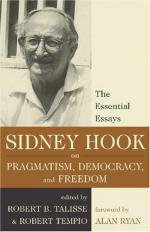
    Sidney Hook
    Although Sidney Hook's academic work spans the gamut of philosophical inquiry, from metaphysics and... more

    Sidney Hook
    Sidney Hook (December 20 1902–July 12 1989) was a prominent New York intellectual and philosop... more


    Copyrights
    Sidney Hook from Encyclopedia of World Biography. ©2005-2006 Thomson Gale, a part of the Thomson Corporation. All rights reserved.

    Join BookRagslearn moreJoin BookRags


    About BookRags | Customer Service | Report an Error | Terms of Use | Privacy Policy

