
 Print
Print Word
Word PDF
PDF|
This section contains 4,844 words (approx. 17 pages at 300 words per page) |

|
Encyclopedia of World Biography on Sandra Cisneros
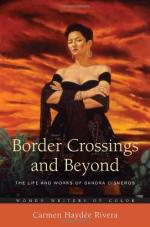
Drawing heavily upon her childhood experiences and ethnic heritage Sandra Cisneros (born 1954) creates characters who are distinctly Hispanic and often isolated from mainstream American culture by emphasizing dialogue and sensory imagery over traditional narrative structures.
Born in Chicago, Cisneros was the only daughter among seven children. Concerning her childhood, Cisneros recalled that because her brothers attempted to control her and expected her to assume a traditional female role, she often felt like she had "seven fathers." The family frequently moved between the United States and Mexico because of her father's homesickness for his native country and his devotion to his mother who lived there. Consequently, Cisneros often felt homeless and displaced: "Because we moved so much, and always in neighborhoods that appeared like France after World War II--empty lots and burned-out buildings--I retreated inside myself." She began to read extensively, finding comfort in such works as Virginia Lee...
|
This section contains 4,844 words (approx. 17 pages at 300 words per page) |
|



