
 Print
Print Word
Word PDF
PDF|
This section contains 378 words (approx. 2 pages at 300 words per page) |
Encyclopedia of World Biography on Samuel Clarke
The English theologian and moral philosopher Samuel Clarke (1675-1729) was in his time the foremost exponent of rationalist ethics and a prominent defender of Newtonian physics.
Samuel Clarke was born on Oct. 11, 1675, in Norwich, where his father was alderman and at one time representative in Parliament. He entered Cambridge University at 16. There he discovered Sir Isaac Newton's Principia mathematica and resolved to advance Newton's theories against those of René Descartes, which were then dominant. His translation of Jacques Rohault's popular physics textbook, with notes and comments reflecting Newton's ideas, was used at Cambridge for several decades.
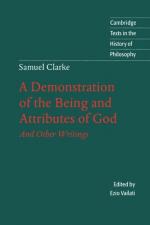
Clarke's ecclesiastical career began as vicar to the bishop of Norwich. In 1704 and 1705 he gave the Boyle Lectures; these were published as A Demonstration of the Being and the Attributes of God (1705-1706) and The Verity and Certitude of Natural and Revealed Religion (1705). They are his chief contributions to philosophy and theology, along with Discourse Concerning the Unchangeable Obligation of Natural Religion (1708). He moved to London in 1706 as rector of St. Benet's Church and later served as chaplain at court. In 1709 he became rector of St. James, Westminster, and he held this position, despite charges of heresy provoked by his Scripture Doctrine of the Trinity (1712), until his death.
Clarke became a friend of Newton in London, and his translation of Newton's Opticks into Latin, warmly praised by the author, was published in 1706. Later he was asked by the Princess of Wales to defend Newton against the German philosopher Gottfried Wilhelm von Leibniz. In the controversy with Leibniz, Clarke supported Newton's theory of absolute space and time. The Clarke-Leibniz correspondence, conducted during 1715-1716, appeared in print in 1717. Clarke also wrote numerous treatises on theology, philosophy, and mathematics; an edition of Caesar's Commentaries; and a translation of the first 12 books of the Iliad. He died on May 17, 1729.
Clarke is best known for his ethical theory, which compares moral and mathematical truths. Right and wrong are known self-evidently, like the axioms of mathematics, and depend on "the necessary eternal different relations that different things bear to one another." They express "fitness or suitableness of certain circumstances to certain persons, and unsuitableness of others." He also argued against materialism and atheism and for free will and the immortality and spirituality of the soul.
|
This section contains 378 words (approx. 2 pages at 300 words per page) |



