
Forgot your password?  

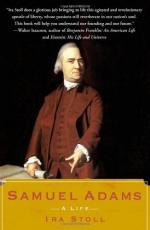
Samuel Adams | Biography

This Biography consists of approximately 5 pages of information about the life of Samuel Adams.
This section contains 1,275 words
(approx. 5 pages at 300 words per page)

Dictionary of Literary Biography on Samuel Adams

Samuel Adams was, according to his cousin John Adams, "born and tempered a wedge of steel to split the knot of lignum vitae" that tied the colonies to Great Britain. Even his Loyalist critics testified to his skill as a political organizer, writer, and molder of public opinion.

Born in Boston, Adams was one of twelve children of Samuel and Mary Fifield Adams. The elder Samuel was a brewer, a deacon in the Old South Church, and active in local politics. Adams attended the Boston Latin School and was graduated from Harvard College in 1740 with a B.A. Three years later he took his M.A. at Harvard, arguing the affirmative of the proposition "Whether it be lawful to resist the Supreme Magistrate, if the Commonwealth cannot otherwise be preserved." Adams studied law briefly, was unsuccessful in a business of his own, and then joined his father in the brewery. He married Elizabeth Checkley in 1749; she died in 1757, leaving two children. In 1764 he married Elizabeth Wells.

Following his father's example, Adams participated actively in local Boston politics. In 1748 he helped to found the Independent Advertiser, a shortlived weekly magazine for which he wrote on political and moral issues. By 1764 his political influence was considerable; in that year he drafted the instructions to Boston's representatives to the General Court, and in 1765 he was elected to the Massachusetts House of Representatives. He was soon the acknowledged leader of the radical party, which controlled the General Court after 1766. Although he led the opposition to the Townshend Acts and was the leader and chief organizer of the Sons of Liberty, nothing in his writings of the 1760s suggests that he was an early agitator for independence. In fact, he explicitly disavowed such an idea in a letter he drafted for the Massachusetts Assembly in January 1768, writing that the citizens of Massachusetts were "so sensible ... of this happiness and safety, in their union with, and dependence upon, the mother country, that they would by no means be inclined to accept of an independency, if offered to them." In an article signed Alfred that was published in the Boston Gazette for 2 October 1769, he expressed fears that the "jealousy between the mother country and the colonies" might finally end in the ruin of "the most glorious Empire the sun ever shone upon." Nevertheless, a persistent theme in Adams's writings is the ever-present and imminent danger of British tyranny. A letter to Christopher Gadsden of South Carolina (December 1766) is typical; after expressing satisfaction and relief at the repeal of the Stamp Act, Adams asks, "But is there no Reason to fear the Liberties of the Colonies may be infringed in a less observable manner? The Stamp Act was like a sword that Nero wished for, to have decollated the Roman People at a stroke, or like Job's Sea monster.... The Sight of such an Enemy at a distance is formidable, while the lurking Serpent lies concealed, and not noticed by the unwary Passenger, darts its fatal Venom. It is necessary then that each Colony should be awake and upon its Guard."

An issue to which Adams devoted much attention was the presence of British troops in Massachusetts. Hoping to enlist the support of every colony in demanding the withdrawal of the troops, Adams sent to sympathetic printers throughout the colonies a "Journal" recounting innumerable British "atrocities": soldiers beating small boys, harassing merchants, violating the Sabbath, and raping Boston women. By fanning Bostonians' hatred of the British troops, Adams probably contributed to the very real tragedy of 1770 known as the Boston Massacre. Yet following the trial of the soldiers involved in that incident, he continued to agitate, writing a series of articles for the Boston Gazette, signed Vindex, attempting to prove the guilt of the soldiers and attributing their acquittal to the shortcomings of the jury. Adams paints the scene in lurid colors, accusing the soldiers of "savage barbarity" and describing bayonets five inches deep in citizen blood. As he continued to agitate against the British troops and against the royal government, he filled the pages of the Boston Gazette not only with his own writing but also with items from other papers, with official documents, and with extracts from correspondence.

Educated in theology, the ancient classics, and the law, Samuel Adams was also thoroughly grounded in the total body of Whig political classics. Three basic principles undergirded his political philosophy: the natural rights of man, the particular rights and privileges granted to the British citizen under the constitution, and the rights and privileges of the colonists granted by the various charters. In the "State of the Rights of the Colonists," adopted by the Boston town meeting 20 November 1772, Adams clearly delineated the Lockian principle that all civil rights are firmly rooted in natural law: "All men have a Right to remain in a State of Nature as long as they please: and in the case of intolerable Oppression, Civil or Religious, to leave the Society they belong to, and enter into another." As late as 1794, having assumed the governorship of Massachusetts, he publicly reaffirmed his strong belief in the principles of natural law and natural rights and the compact theory of government.

Samuel Adams was a thorough Puritan who considered the most important legacy of New England's founding fathers to be their zeal and virtue. He saw in the era of political crisis surrounding the American Revolution an opportunity for "recovering the Virtue and reforming the Manners of our Country." Included in his idea of virtue was the subordination of self-interest to community interest: "It would be the glory of this Age, to find Men having no ruling Passion but the Love of their Country, and ready to render her the most arduous and important Services with the Hope of no other Reward in this Life than the Esteem of their virtuous Fellow Citizens." Subordination of self to country permeated Adams's own life and writings; he was ambitious for neither social status nor material wealth. It is said that when he left for Philadelphia to represent Massachusetts at the Continental Congress, his friends, embarrassed by the condition of his clothing, presented him with a complete new outfit and some spending money. "For my own part," he wrote in 1774, "I have been wont to converse with poverty; and however disagreeable she may be thought to be by the affluent and luxurious who never were acquainted with her, I can live happily with her the remainder of my days, if I can thereby contribute to the redemption of my Country."

Adams was a member of both the First and Second Continental Congresses and signed the Declaration of Independence. He served as a member of the Massachusetts Constitutional Convention and in 1789 was elected lieutenant governor under John Hancock. Adams became governor upon Hancock's death in 1793 and was elected to that office in 1794.

John Adams wrote in 1817 that "Without the character of Samuel Adams, the true history of the American Revolution can never be written. For fifty years, his pen, his tongue, his activity, were constantly exerted for his country without fee or reward." Samuel Adams's writings included resolutions and instructions of the town of Boston, official letters, resolutions, and appeals of the Massachusetts House of Representatives and circular letters of the Committees of Correspondence. His hundreds of articles in the Boston newspapers appeared under as many as twenty-five different pseudonyms. In addition he kept up a steady correspondence with political leaders throughout the colonies and in England. His writings, along with his other activities, were unquestionably a major propaganda force of the revolutionary era.

This section contains 1,275 words
(approx. 5 pages at 300 words per page)
Copyrights
Samuel Adams from Dictionary of Literary Biography. ©2005-2006 Thomson Gale, a part of the Thomson Corporation. All rights reserved.
Follow Us on Facebook
Homework Help

