 Print
Print Word
Word PDF
PDF|
This section contains 3,756 words (approx. 13 pages at 300 words per page) |

|
Authors and Artists for Young Adults on Sam Shepard
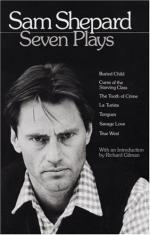
"Sam Shepard's perennial theme isn't nostalgia for the Old West or depicting the tortured artist in society," wrote Michael Green of Backstage West, "not even dysfunctional families (though they're part of it). It's displaying emotional primitives--characters bristling with raw energy, chaos, and contradictions, whose only defenses are fearful hiding, flight, or violence, who want to jump out of their skins and end up bolting their circumstances as best as they can do." For Green, "a good production of Shepard gives zero insight but makes you feel the lives of its characters in your gut." Hal Gelb, writing in the Nation, found Shepard's early plays to be "like no others--fresh, hip, antiheroic, free from the tired old psychology of Tennessee Williams and the Actor's Studio. By no means political, they nevertheless made us aware of the myths that shaped our behavior as Americans." Gelb dubbed Shepard "the best playwright...
|
This section contains 3,756 words (approx. 13 pages at 300 words per page) |
|