BookRags.com Literature Guides Literature
Guides
Criticism & Essays Criticism &
Essays
Questions & Answers Questions &
Answers
Lesson Plans Lesson
Plans
My Bibliography Periodic Table U.S. Presidents Shakespeare Sonnet Shake-Up
Research Anything:        
History | Encyclopedias | Films | News | Create a Bibliography | More... Login | Register | Help

Search "Rosalind Franklin"

Biographies Navigation
 
Not What You Meant?  There are 10 definitions for Rosalind.

Rosalind Franklin Biography

Print-Friendly  Order the PDF version  Order the RTF version
About 2 pages (674 words)
Rosalind Franklin Summary

Bookmark and Share Know this topic well? Help others and get FREE products!
Name: Rosalind Elsie Franklin
Birth Date: July 25, 1920
Death Date: April 16, 1958
Place of Birth: London, England
Nationality: English
Gender: Female
Occupations: chemist, biologist

World of Biology on Rosalind Franklin

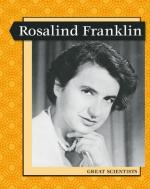
Rosalind Franklin was born on July 25 in London, England, the daughter of an affluent Jewish family. At the age of 15, Franklin determined she would become a scientist--a daunting aspiration for a young girl in what was then a decidedly male-dominated field. Franklin's most famous work--done between 1951 and 1953--involved the use of a new invention known as x-ray crystallography. Using this technology, she produced the first clear photos of a deoxyribonucleic acid (DNA) molecule. These photographs ultimately led to the identification of DNA's double helix structure. She died of ovarian cancer at the age of 37.

As a youth, Franklin attended St. Paul's Girls' School, one of the few girls' schools in London at that time which taught chemistry and physics. Her father adamantly opposed her attending university, insisting she go into social work. However, she ultimately gained his approval to attend Newnham College at Cambridge University. She obtained a bachelor of arts degree in 1941 and then accepted a fellowship there, which she relinquished a year later to take her first position at the British Coal Utilization Research Association. There she focused on the structure of graphite and other carbons, using her analytical skills and chemistry background to differentiate between carbons that became graphite when heated and those that did not. She used this research as the subject for her doctoral studies.

After earning her doctorate in physical chemistry at Cambridge in 1945, Franklin travelled to Paris, working in the Laboratoire Central des Services Chimiques de L'Etat from 1947 until 1950. There she was introduced to and began using the newly-developed technology of x-ray diffraction known as x-ray crystallography with which atoms could be identified and mapped in any type of crystal.

Upon returning to England in 1951, she was hired as a research associate in the lab of John Randall at King's College, University of London. Randall gave her sole responsibility for researching DNA, a project which had been begun but on which no work had been done for some time. From 1951 to 1953 she studied the structure of DNA. Using a precise and painstaking analysis which she gained her noteriety, she determined--and was the first to report-- that the sugar-phosphate backbone was on the outside rather than the inside of the DNA molecule while gleaning crucial evidence of the molecule's two- stranded, helical structure. J. D. Bernal, a noted peer, called her photographs of the DNA molecule "...among the most beautiful x-ray photographs of any substance ever taken."

At the height of her research, before she documented or published her findings, Randall shared her discoveries with colleagues at a routine seminar. Apparently some friction existed between Franklin and another colleague at the lab, Maurice Wilkins, who also had an interest in DNA but had been assigned by Randall to a different project. In several historical accounts, Wilkins is reported to have had difficulty accepting a woman as his peer. Regardless, he obtained one of Franklin's DNA photographs and, without permission from either her or Randall, showed it to her competitors at Cambridge--James Watson and Francis Crick. This team used her data, along with information gleaned from other scientists, to accurately define and describe the double helix structure of DNA. They quickly publishing their findings in Nature. Although a supporting article on Franklin's work was published in the same issue, she received little credit for her crucial role in solving the DNA riddle.

Following her work on DNA, Franklin began studying the structure of the polio virus and plant viruses. She showed that the tobacco mosaic virus was a hollow tube rather solid, as previously thought, and its ribonucleic acid (RNA) was contained within the protein, not inside the tube.

In 1962, several years after Franklin's untimely death, Wilkins, Watson, and Crick received the Nobel Prize for physiology or medicine for discovering the structure of DNA. No reference was made to Franklin's work, and debate still continues among the scientific and other community as to whether sexism may have played a significant role in denying Franklin due recognition for her important contribution to the discovery.

This is the complete article, containing 674 words (approx. 2 pages at 300 words per page).

View More Summaries on Rosalind Franklin
More Information
  • View Rosalind Franklin Study Pack
  • 10 Alternative Definitions
  • Search Results for "Rosalind Franklin"
  • Add This to Your Bibliography
  • More Products on This Subject
    Rosalind Elsie Franklin
    The British physical chemist and molecular biologist Rosalind Elsie Franklin (1920-1958) made her m... more

    Rosalind Elsie Franklin
    Deoxyribonucleic acid (DNA) carries the genetic instructions for life. Johann Miescher (1844-1895),... more


    Ask any question on Rosalind Franklin and get it answered FAST!
    Answer questions in BookRags Q&A and earn points toward
    discounted or even FREE Study Guides and other BookRags products!
    Learn more about BookRags Q&A
    Copyrights
    Rosalind Franklin from World of Biology. ©2005-2006 Thomson Gale, a part of the Thomson Corporation. All rights reserved.

    Join BookRagslearn moreJoin BookRags


    About BookRags | Customer Service | Report an Error | Terms of Use | Privacy Policy