BookRags.com Literature Guides Literature
Guides
Criticism & Essays Criticism &
Essays
Questions & Answers Questions &
Answers
Lesson Plans Lesson
Plans
My Bibliography Periodic Table U.S. Presidents Shakespeare Sonnet Shake-Up
Research Anything:        
History | Encyclopedias | Films | News | Create a Bibliography | More... Login | Register | Help

Search "Rosalind Elsie Franklin"

Biographies Navigation
 
Not What You Meant?  There are 10 definitions for Rosalind.

Rosalind Elsie Franklin Biography

Print-Friendly  Order the PDF version  Order the RTF version
About 2 pages (438 words)
Rosalind Franklin Summary

Bookmark and Share Questions on this topic? Just ask!
Name: Rosalind Elsie Franklin
Birth Date: July 25, 1920
Death Date: April 16, 1958
Place of Birth: London, England
Nationality: English
Gender: Female
Occupations: chemist, biologist

World of Scientific Discovery on Rosalind Elsie Franklin

Deoxyribonucleic acid (DNA) carries the genetic instructions for life. Johann Miescher (1844-1895), a Swiss physician, discovered DNA in 1869 while studying the composition of white blood cells. Nearly one hundred years passed before James Watson and Francis Crick were credited with the discovery of the actual structure of DNA. Many scientists contributed to this discovery--not the least of whom was Rosalind Franklin.

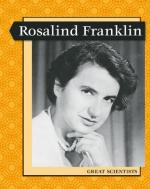
Franklin was born in London on July 25, 1920. She graduated from Cambridge University in 1941. She conducted experiments using chromatographic techniques and later worked at a laboratory in Paris, France, where she learned to develop x-ray diffraction photographs. In 1951, she used these skills to carefully construct x-ray diffraction photos of DNA under varying degrees of humidity. Together with her colleague, Maurice Wilkins, she noted that the pictures showed the molecule to be a helical shape. She remained skeptical, however, that DNA would actually take up a helical form under all conditions.

James Watson was later shown the photographs by Wilkins, apparently without the consent of Franklin. The photographs strongly supported Watson and Crick's hypothesis of a double-stranded helical DNA molecule. In 1953, this model was publicly presented by Watson and Crick. The double-helix, or twisted ladder shape, is made of sugar-phosphate units of nucleotides. These nucleotides form the sides of the ladder. The rungs are formed by four nitrogenous bases, including adenine and guanine (the purines) and thymine and cytosine (the pyrimidines). Each rung consists of two bases. Knowledge of the distances between the atoms, as determined by x-ray diffraction, was crucial in establishing the structure of the DNA model.

Francis Crick admitted in a Nature article that "Rosalind Franklin was only two steps away from the solution. She needed to realize that the two chains must run in opposite directions and that the bases, in their correct tautomeric forms, were paired together." Although Franklin was on the verge of solving the mystery of DNA structure, it was during this time that she chose to leave King's College and DNA to study the tobacco mosaic virus. She was instrumental in showing how the nucleic acid molecules of the virus existed in a helical array of repeated protein units.

Perhaps Rosalind Franklin's most amazing accomplishment is the relatively short period of time in which she contributed such valuable scientific information. She died in London of cancer on April 16, 1958, at the early age of 37. This was four years before Watson, Crick, and Wilkins received the Nobel Prize in physiology or medicine. Many people believe that Franklin's work has been underestimated due to her untimely death and the female prejudices of the English scientific establishment in the 1950s.

This is the complete article, containing 438 words (approx. 1 page at 300 words per page).

View More Summaries on Rosalind Franklin
More Information
  • View Rosalind Elsie Franklin Study Pack
  • 10 Alternative Definitions
  • Search Results for "Rosalind Elsie Franklin"
  • Add This to Your Bibliography
  • More Products on This Subject
    Rosalind Elsie Franklin
    The British physical chemist and molecular biologist Rosalind Elsie Franklin (1920-1958) made her m... more

    Rosalind Elsie Franklin
    The story of a great scientific discovery usually involves a combination of inspiration, hard work,... more


    Ask any question on Rosalind Franklin and get it answered FAST!
    Answer questions in BookRags Q&A and earn points toward
    discounted or even FREE Study Guides and other BookRags products!
    Learn more about BookRags Q&A
    Copyrights
    Rosalind Elsie Franklin from World of Scientific Discovery. ©2005-2006 Thomson Gale, a part of the Thomson Corporation. All rights reserved.

    Join BookRagslearn moreJoin BookRags


    About BookRags | Customer Service | Report an Error | Terms of Use | Privacy Policy